
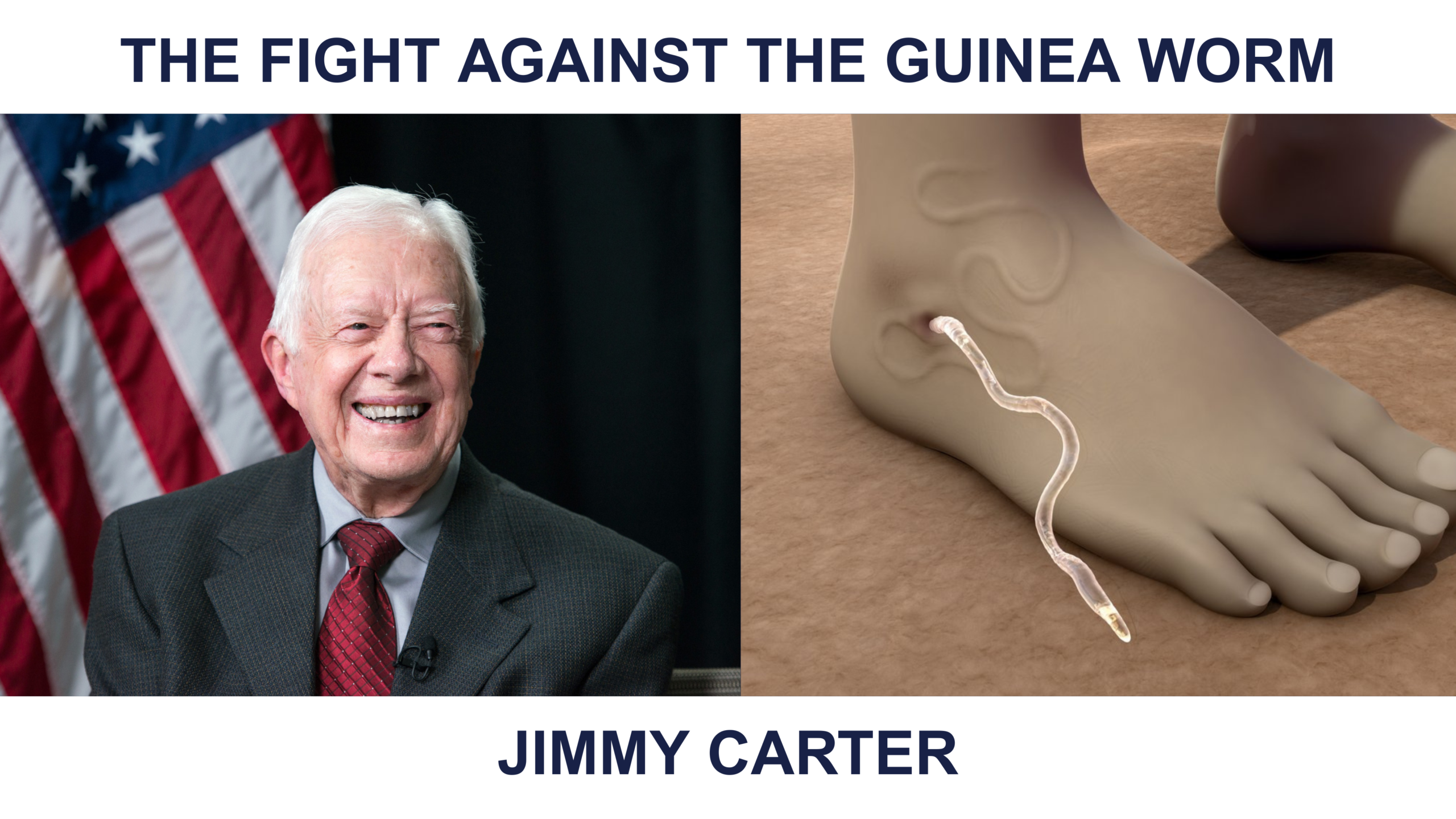
January 20, 1981. Jimmy Carter walked out of the White House for the last time as president. He was fifty-six years old. Most men in his position would have retreated into legacy management—speeches, libraries, corporate boards, comfortable reflection. Carter looked at the world and saw something else: work left unfinished.
He chose a target that no one else thought was worth fighting.
The Guinea worm—Dracunculus medinensis, “the fiery serpent”—had terrorized human beings since ancient times. Egyptian mummies bear evidence of the infection. It appears in ancient Persian texts. The creature’s life cycle was grotesque and intimate: microscopic larvae lurked in contaminated water, invisible to the naked eye. When someone drank, the larvae entered the body and burrowed into tissue.
For a year, nothing happened. The person felt fine.
Then the worm began to grow. A meter long, sometimes more, coiled inside muscle and connective tissue. When it was ready to reproduce, it released a chemical that caused excruciating burning pain, driving the victim toward water for relief. The moment skin touched liquid, the worm broke through the flesh—an agonizing emergence that could take weeks—and released thousands of larvae into the water, restarting the cycle.
There was no cure. No vaccine. No medicine. Only suffering, infection, and disability that could last for months. In the early 1980s, an estimated 3.5 million people in 21 countries across Africa and Asia were infected every year. Entire villages were crippled during planting and harvest seasons. Children missed school. Adults couldn’t work. The pain was unbearable.
The world had largely ignored it. Guinea worm disease struck the poorest, most remote communities—people with no access to clean water, no political voice, no economic power. It wasn’t deadly enough to attract global funding. It wasn’t fast-spreading enough to panic wealthy nations. It was just another ancient misery that humanity had learned to live with.
Carter decided that was unacceptable.
In 1986, he and The Carter Center launched an eradication campaign. Not with cutting-edge drugs or billion-dollar research facilities, but with something simpler and far harder: community-level education, local empowerment, and unrelenting persistence.
The strategy was almost shockingly low-tech. Villagers were given simple cloth filters to strain drinking water, removing the larvae before they could infect anyone. Health workers taught people to avoid entering water sources when they had infections, breaking the transmission cycle. Every single case was tracked, documented, and isolated. Patients were given basic wound care to prevent secondary infections.
It was slow. It was exhausting. It required visiting thousands of remote villages, training tens of thousands of health workers, and convincing entire communities to change behaviors passed down for generations.
Carter didn’t just fund it. He lived it.
He traveled to some of the poorest, most isolated regions on Earth—rural Ethiopia, South Sudan, Chad, Mali—places most former presidents would never see. He sat with victims in dirt-floor huts. He inspected contaminated ponds. He knelt beside people in unimaginable pain, helping health workers tend to open wounds where the worms were slowly emerging. Photographs show him—a former leader of the free world—crouched in the dust, his sleeves rolled up, focused entirely on the person in front of him.
The numbers began to change.
By 1995, cases had dropped to 75,000. By 2001, they’d fallen by 98%. By 2007, fewer than 10,000 cases remained. By 2015, the number was 126. In 2023, only 13 human cases were reported worldwide—down from 3.5 million.
The Guinea worm is now on the verge of becoming only the second human disease ever eradicated, after smallpox. Unlike smallpox, this was achieved without a single vaccine, without a pharmaceutical breakthrough, without a miracle drug. It was done with cloth filters, education, and the relentless belief that forgotten people deserve the same dignity as everyone else.
Carter died in 2024 having outlived most of his peers, most of his critics, and nearly all of the parasites he swore to destroy. In 2015, weak but determined, he said: “I’d like the last Guinea worm to die before I do.”
That wasn’t bravado. It was a mission statement.
And he’s closer than anyone thought possible.
There are people alive today—millions of them—who never contracted Guinea worm disease because a man who once had the most powerful job on Earth decided that the most important thing he could do was fight for people the world had forgotten. Children who went to school instead of lying in pain. Farmers who harvested their crops. Women who carried water without fear.
Carter didn’t cure cancer. He didn’t negotiate world peace. He didn’t build monuments to himself.
He waged war on a worm—and won.
Most presidential legacies are measured in legislation, in wars fought or avoided, in economic policies and Supreme Court appointments. Those things matter. But they fade, they’re reinterpreted, they’re undone by successors.
Eradicating a disease? That’s forever.
Three and a half million people suffered every year. Now, fewer than twenty do. That transformation didn’t happen because of technology or wealth or military power. It happened because one man believed that some wars are worth fighting even when no one’s watching, even when there’s no political gain, even when the enemy is microscopic and the battlefield is a village no one’s heard of.
Jimmy Carter proved that the most powerful thing a president can do might be what comes after.
Would you call that the greatest legacy a president ever left behind?
