
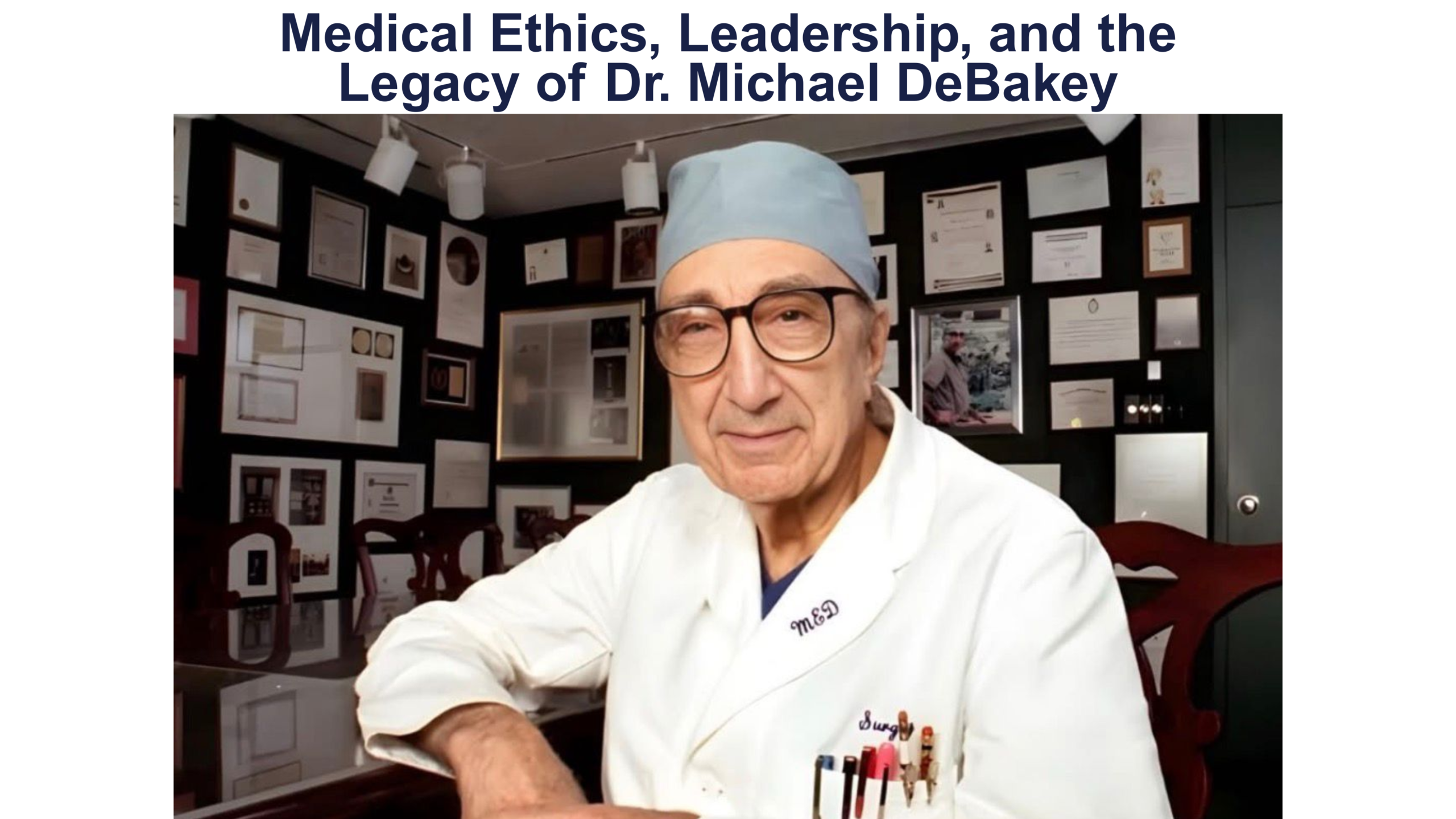
On New Year’s Eve in 2005, Michael DeBakey — widely regarded as one of the most accomplished cardiothoracic and vascular surgeons in history — was alone in his study preparing for an upcoming lecture when he felt a sudden, sharp pain tear through his upper chest, radiating between his shoulder blades and into his neck. At ninety-seven years old, he instantly recognized the diagnosis: an acute aortic dissection, a catastrophic tearing of the inner wall of the body’s largest artery. He knew the condition intimately. He had classified it; the DeBakey classification system bears his name. He had pioneered the surgical repair for it. He had trained hundreds of surgeons worldwide to perform the procedure. Now, it was happening to him. Expecting his heart to stop within seconds, he instead endured excruciating pain. Later, in an interview with The New York Times, he explained that he never considered calling emergency services, describing himself as “a prisoner of the pain,” adding that when pain becomes intense enough, one is almost willing to accept cardiac arrest simply to escape it. A CT scan confirmed his diagnosis. Physicians at Houston’s Methodist Hospital recommended immediate surgery. DeBakey refused and returned home.
His refusal was not impulsive but deeply informed. As a surgeon, he understood better than anyone the toll such a complex operation would take on a ninety-seven-year-old body. He had witnessed elderly patients survive surgery only to live in diminished physical or mental states. He chose instead to face death on his own terms. He signed a do-not-resuscitate (DNR) order and clearly documented in his medical chart that he did not want surgery. Remarkably, just one week after nearly dying, he proceeded to deliver the lecture he had been preparing. For three weeks, physicians monitored him at home, managing his blood pressure in hopes that the dissection would stabilize. It did not. The tear progressed, he was readmitted to the hospital, and his condition deteriorated until he became unresponsive.
What followed became one of the most extraordinary medical ethics debates in modern history. His wife, Katrin, and his longtime colleague, Dr. George Noon, urged surgical intervention. However, the highly experienced cardiac anesthesiology team at Methodist Hospital refused to participate, citing his DNR directive and documented refusal of surgery. The hospital’s ethics committee convened to address a profound question: should physicians honor the explicit wishes of a patient, or attempt to save the unconscious inventor of the very operation capable of rescuing him? The impasse was ultimately broken by Katrin DeBakey, who reportedly declared that her husband would die before any action could be taken unless they proceeded immediately. The ethics committee approved surgery.
On February 9, 2006, an anesthesiology team from another hospital — as the Methodist team maintained their refusal — administered anesthesia. Many members of the surgical team were DeBakey’s former trainees. They performed a seven-hour operation, replacing the torn segment of his aorta with a Dacron graft — the very type of graft DeBakey himself had invented decades earlier. The original graft material had been fashioned using Dacron fabric, sewn on his wife’s sewing machine after a department store happened to be out of Nylon. The recovery was arduous, lasting eight months, and the hospital expenses exceeded one million dollars. Yet Michael DeBakey survived and ultimately walked out of the hospital alive.
To fully understand the magnitude of this moment, one must appreciate the scope of his life’s work. Born Michel Dabaghi in 1908 in Lake Charles, Louisiana, to Lebanese immigrant parents, he grew up in his father’s pharmacy, where interactions with visiting physicians first sparked his interest in medicine. His mother taught him to sew, and by the age of ten he could make his own shirts. Before completing high school, he had read the entire Encyclopedia Britannica cover to cover. While still a medical student at Tulane University in his early twenties, he invented the roller pump, a blood transfusion device that later became a critical component of the heart-lung machine, enabling the development of open-heart surgery. Over the course of his career, he performed more than sixty thousand cardiovascular operations and achieved numerous milestones: performing the first carotid endarterectomy, pioneering coronary artery bypass surgery, developing functional Dacron vascular grafts, advancing left-ventricular assist devices, and conducting some of the earliest multiple-organ transplants from a single donor. During World War II, he played a central role in the creation of the Mobile Army Surgical Hospital (MASH) units. He was among the first physicians to link cigarette smoking to lung cancer. He also supervised heart surgery on Russian President Boris Yeltsin.
By every measurable standard, he was one of the most consequential physicians in modern medical history. Yet he was also widely regarded as intimidating and exacting. His surgical rounds began at five o’clock each morning, often attended by fifty or more students, residents, and visiting surgeons. Stories circulated for decades describing his fierce temper, public humiliation of trainees, and even physical confrontations over missed details. He demanded absolute precision. Although the emotional toll on trainees was significant and acknowledged, his patient survival rates were extraordinary.
Following his 2006 surgery, DeBakey made a full recovery. He returned to academic work, authored papers, delivered lectures, and expressed gratitude to the team that had overruled his prior wishes. On April 23, 2008, at age ninety-nine, he was awarded the Congressional Gold Medal by U.S. President George W. Bush. On July 11, 2008, less than two months before what would have been his one-hundredth birthday, he died of heart failure at the hospital that bears his name.
The extraordinary paradox of his story lies not merely in his list of medical “firsts,” but in its final contradiction. He invented the classification system for the disease that nearly killed him. He developed the operation used to treat it. He trained the surgeons who performed it. He created the graft implanted in his body. And he had initially tried to prevent them from saving him. Yet they used his classifications, his surgical techniques, his grafts, and even the sewing skills he learned from his mother — and they used them on him. The man who taught the world to fight relentlessly for every heartbeat ultimately had to be convinced that his own was still worth fighting for. In that profound act, his students delivered the ultimate “guru dakshina” — repaying their teacher not with words, but by preserving his life through the very legacy he built.
