
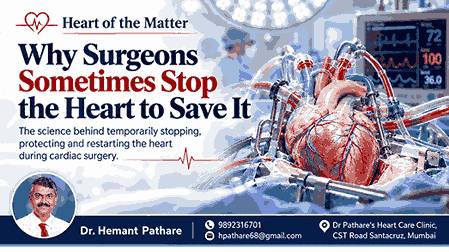
Imagine being told that during your heart surgery, your surgeon may deliberately stop your heart from beating.
For most patients, that would be a frightening thought.
The heart is an organ we expect to work continuously. Every beat keeps blood circulating, delivering oxygen to the brain and other vital organs.
So why would a surgeon intentionally stop it? And how can the body continue functioning while the heart is still?
The answer lies in a remarkable capability of modern cardiac surgery: temporarily taking over the heart’s pumping function while protecting the heart muscle and performing a precise repair.
Why Would a Surgeon Need a Still Heart?
The heart never stays still. It continuously contracts and relaxes, making certain surgical repairs technically challenging.
Consider a damaged heart valve that needs to be repaired or replaced. The surgeon must work with delicate structures where precision matters enormously.
In many such procedures, a motionless heart provides a controlled operating field, making it possible to perform intricate repairs without the constant movement of each heartbeat.
But this creates an immediate challenge.
If the heart stops pumping, what keeps blood flowing to the rest of the body?
When a Machine Temporarily Takes Overy Takes Over
During many open-heart procedures, surgeons use a technique called cardiopulmonary bypass.
A heart–lung machine temporarily takes over two essential functions: circulating blood and ensuring that it receives oxygen while carbon dioxide is removed.
Blood is directed through a specialised circuit outside the body, passes through an oxygenator and is then pumped back into the circulation.
Throughout the procedure, a perfusionist works closely with the surgical and anaesthesia teams to monitor blood flow, oxygen delivery and other important parameters.
This allows the brain, kidneys and other organs to continue receiving oxygenated blood while the surgeon works on the heart.
However, maintaining circulation to the rest of the body is only part of the challenge.
The heart muscle itself must also be protected.
How Do Surgeons Protect a Heart That Is Not Beating?
The heart has its own blood supply, delivered through the coronary arteries. Like other muscles, it needs oxygen and energy to function.
During certain operations, this blood supply must be temporarily interrupted.
Without appropriate protection, the heart muscle could suffer injury.
To reduce that risk, surgeons use a technique called cardioplegia.
A specially formulated solution, commonly containing potassium, is delivered to the heart to produce a controlled, temporary arrest.
By stopping the heart’s contractions, cardioplegia substantially reduces its energy requirements. Depending on the procedure and the technique used, cooling and additional doses of cardioplegia may also help protect the heart muscle during the operation.
This protection is carefully managed throughout the period of arrest.
The important distinction is that cardioplegia serves two purposes: it provides the still operating field the surgeon needs and helps preserve the heart muscle until normal blood flow can be restored.
Stopping the heart is only one part of the process. Protecting it is equally important.
What Happens When the Surgery Is Complete?
Once the necessary repair has been performed, blood flow to the heart muscle is restored.
As the effects of cardioplegia wear off, the heart can begin contracting again.
In many cases, it resumes beating spontaneously. Sometimes, temporary electrical pacing, medication or a controlled electrical shock may be required to establish or support an effective rhythm.
The team then carefully assesses the heart’s pumping function.
Support from the heart–lung machine is gradually reduced as the heart and lungs resume their normal roles.
This transition is an important part of the operation.
The surgeon’s responsibility does not end with completing the repair. The heart must also be capable of maintaining adequate circulation once mechanical support is withdrawn.
Is This the Same as Sudden Cardiac Arrest?
No. And this distinction is particularly important for patients and their families.
When someone experiences sudden cardiac arrest, the heart unexpectedly stops pumping blood effectively. Without immediate treatment, the brain and other organs rapidly become deprived of oxygen.
During planned cardiac surgery, however, the situation is fundamentally different.
The patient is under general anaesthesia, circulation is maintained through specialised equipment, and the heart is protected using established surgical techniques.
The heart is not being allowed to fail unexpectedly. Its activity is being temporarily controlled as part of a planned operation.
Understanding this difference can help patients approach the procedure with greater clarity
Does Every Heart Surgery Require Stopping the Heart?
Not necessarily.
Certain coronary artery bypass operations can be performed while the heart continues beating. This is known as off-pump or beating-heart bypass surgery.
In these procedures, specialised instruments stabilise the area where the surgeon is attaching a bypass graft, while the heart continues pumping blood.
Other operations, particularly those involving structures inside the heart, may require cardiopulmonary bypass and a still operating field.
Neither approach is automatically superior for every patient.
The decision depends on the nature of the heart condition, the complexity of the repair, the patient’s overall health and the experience of the surgical team.
Both approaches have benefits, limitations and potential risks.
For the surgeon, the objective is not simply to avoid stopping the heart whenever possible. It is to select the technique that offers the most appropriate conditions for a safe and effective repair.
The Purpose Behind the Pause
Cardiac surgery has advanced to a point where surgeons can temporarily stop the heart, maintain circulation through a mechanical system and protect the heart muscle while performing complex repairs.
But none of this makes the procedure risk-free.
Cardiopulmonary bypass and temporary interruption of the heart’s normal blood supply carry potential complications. Protecting the heart and other organs requires careful planning, precise execution and continuous monitoring.
Every decision must account for the patient’s condition and the demands of the operation.
For patients, the thought of their heart being deliberately stopped may initially seem difficult to understand.
But the purpose is not to interrupt life. It is to create the conditions needed to repair an organ that sustains it.
And that is one of the remarkable achievements of modern cardiac surgery.
Sometimes, to help the heart continue beating for years to come, surgeons must first bring it to a carefully controlled pause.
