
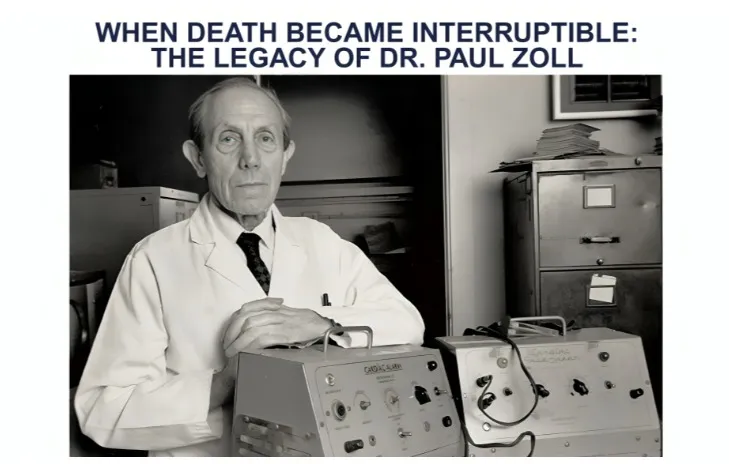
In 1952, a quiet moment at a hospital bedside changed medicine forever. At that time, when a human heart stopped, there were no emergency codes, no crash carts, and no defibrillators rushing through hospital corridors. There was only waiting—and waiting usually meant death. Dr. Paul Zoll refused to accept that reality.
His determination was shaped years earlier by a failure that haunted him. In 1947, while working at Beth Israel Hospital in Boston, a woman suffered repeated fainting spells, each episode longer than the last and increasingly dangerous. Despite every available intervention, her heart eventually stopped and could not be restarted. The autopsy was devastating. Her heart muscle was entirely healthy; the only problem was a faulty electrical conduction system. The signal that tells the heart to beat had failed. Staring at a structurally normal heart, Zoll said, “This should not happen. It should be possible to stimulate the heart.” That conviction became the central pursuit of his life.
Zoll’s thinking was deeply influenced by his wartime experience. From 1941 to 1946, during World War II, he served as an Army physician, first in the Aleutian Islands and later in England, where he became Chief of Medicine at the 160th General Hospital, a facility designated for wounded military evacuees with severe chest injuries. Working alongside surgeon Dr. Dwight Harken, Zoll helped remove bullets and shrapnel from inside beating hearts—an act previously considered impossible. Together, they treated 138 soldiers with injuries involving the heart and great vessels without a single fatality. During these procedures, Zoll observed something remarkable: even the slightest electrical contact with the heart caused it to contract, every single time. That observation stayed with him long after the war ended. If hearts responded so reliably to electricity during surgery, he wondered, why could they not be stimulated from outside the chest when they stopped?
For five years, Zoll pursued that question with relentless focus. He built experimental devices, tested them, failed, refined them, and tried again. Then, in 1952, a 65-year-old man with end-stage heart disease and complete heart block was brought to him. The patient’s heart had already stopped and restarted multiple times, each pause bringing him closer to death. When the heart stopped again, Zoll made a decision that had never before been attempted. He placed two electrodes on the man’s bare chest, connected them to a bulky experimental machine borrowed from Harvard Medical School, and delivered controlled electrical pulses to the motionless heart—two milliseconds per pulse, 100 to 150 volts, sixty times per minute. The heart responded. It beat, then beat again, and continued beating. For 52 continuous hours, Zoll maintained the patient’s heartbeat from outside the body. The man survived for another six months, time that by every medical standard should not have existed.
When Zoll presented his findings at a medical conference, skepticism was immediate. A leading cardiologist dismissed the device as “a toy with little medical use,” making the remark to Zoll’s wife rather than to him. Yet patients continued to survive. Hours turned into days, and days became undeniable evidence. Zoll pressed forward.
In 1953, working with engineer Alan Belgard, Zoll introduced another revolutionary innovation: machines capable of continuously monitoring the heart. These devices displayed each heartbeat on a screen and sounded an alarm the moment a heart stopped. For the first time, physicians no longer needed to stand vigil over every critically ill patient. A machine could watch continuously. These monitors became the foundation of coronary care units around the world.
Zoll’s most dramatic advance followed in 1956, when he demonstrated that chaotic and fatal heart rhythms, particularly ventricular fibrillation, could be stopped using powerful electrical shocks delivered through the chest wall. Until then, defibrillation required surgically opening the chest to apply the shock directly to the heart. Zoll eliminated the need for incision. Using up to 750 volts across the chest, hearts quivering uselessly suddenly snapped back into organized rhythm. In that moment, sudden death ceased to be absolute. It became interruptible.
By 1960, working with thoracic surgeon Howard Frank, Zoll’s team became the second in the world to implant a long-term pacemaker in an adult. Shortly thereafter, they became the first to implant a pacemaker in a child—an eight-year-old whose heart could now beat reliably. Entire hospital systems evolved from these early breakthroughs, including coronary care units, emergency defibrillation protocols, and continuous cardiac monitoring. All of it traced back to one physician’s refusal to accept that a stopped heart meant the end.
For decades, Zoll’s name remained largely confined to medical journals while his inventions spread across hospitals and ambulances worldwide. Recognition came slowly. In 1973, he received the Albert Lasker Award, one of medicine’s highest honors, often referred to as the “American Nobel.” In 1980, at the age of 69, he co-founded ZOLL Medical Corporation, which continues to manufacture the defibrillators and pacemakers used in hospitals, ambulances, schools, airports, and public spaces around the world. The automated external defibrillators seen in public places today trace their lineage directly to Zoll’s 1956 external defibrillator.
The scale of his impact is extraordinary. More than 500,000 Americans are alive today because of implanted pacemakers descended from Zoll’s technology. Approximately 450,000 Americans experience sudden cardiac arrest each year, and thousands survive because of machines and emergency protocols that originated from Zoll’s work in a Boston hospital in the 1950s.
Paul Zoll’s journey began long before those breakthroughs. He graduated from Boston Latin School in 1928 and followed his brother to Harvard College, where he majored in psychology with aspirations of an academic career. Concerned about job security after seeing his brother struggle to find a teaching position, his mother encouraged him to pursue medicine. Zoll graduated summa cum laude from Harvard College in 1932 and entered Harvard Medical School, where his exceptional academic standing allowed him to spend part of his senior year conducting cardiac research under Soma Weiss.
Dr. Paul Zoll died on January 5, 1999, at the age of 87. His legacy lives on in every beeping monitor, every implanted pacemaker, and every defibrillator that delivers a life-restoring shock. He did not invent hope; he demonstrated that stopping was not the same as ending. By making death interruptible—if only briefly—he gave millions of people something invaluable: more time.
— Arun Gupta, MD, FACC
