
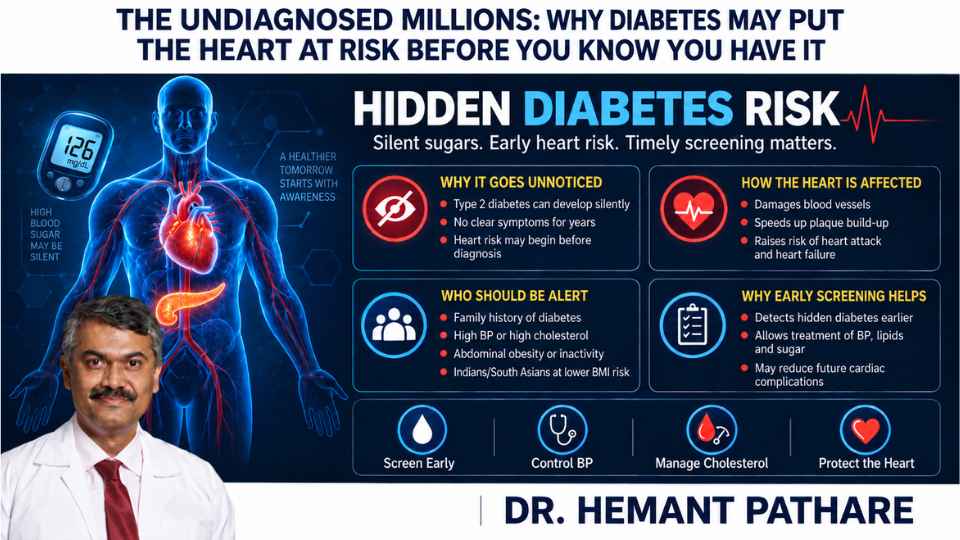
Diabetes is often imagined as a disease that announces itself.
Excessive thirst. Frequent urination. Unexplained weight loss. Fatigue. A blood test that finally crosses the diagnostic threshold.
Type 2 diabetes does not always behave that way.
Blood glucose can remain elevated for years without producing symptoms dramatic enough to bring someone to a doctor. During that time, the person may be going to work, exercising, travelling and feeling reasonably well.
The absence of symptoms can be reassuring.
The metabolism may tell a different story.
According to the 2025 International Diabetes Federation Atlas, India had an estimated 89.8 million adults aged 20–79 living with diabetes in 2024. About 43%-approximately 38.6 million people-were estimated to be undiagnosed.
The real concern behind undiagnosed diabetes is not simply that millions of people do not know their blood sugar is high, but that cardiovascular risk does not wait for the diagnosis to be made.
Diabetes Usually Begins Before the Day It Is Diagnosed
A diagnosis has a date.
The disease process usually does not.
Type 2 diabetes generally develops gradually. The body’s tissues become less responsive to insulin-a state known as insulin resistance. The pancreas initially compensates by producing more insulin, often keeping glucose within or close to the normal range.
Eventually, that compensation becomes insufficient.
Blood glucose rises.
Prediabetes may appear first, followed eventually by levels that meet the diagnostic criteria for diabetes.
This progression can occur quietly.
And while glucose is rising, other abnormalities often travel alongside it: increased blood pressure, abnormal cholesterol and triglycerides, abdominal fat, inflammation and changes in blood-vessel function.
Importantly, even prediabetes is associated with increased cardiovascular risk, which is why current diabetes guidance recommends that cardiovascular risk factors be identified and treated rather than waiting for diabetes itself to develop.
The cardiovascular story therefore begins earlier than many people realise.
What Does High Blood Sugar Have to Do With the Heart?
The connection is not as simple as sugar physically “blocking” an artery.
Persistently elevated glucose contributes to a biological environment that is unfavourable to blood vessels.
It impairs the endothelium, the thin inner lining of arteries that helps regulate blood flow and vascular health. Diabetes is also associated with inflammation, oxidative stress and abnormalities in lipid metabolism.
At the same time, many people with type 2 diabetes have other cardiovascular risk factors such as hypertension, high LDL cholesterol, elevated triglycerides, excess abdominal fat or smoking.
Together, these factors can accelerate atherosclerosis-the gradual accumulation of cholesterol-rich plaque in arterial walls.
When this occurs in the coronary arteries supplying the heart muscle, blood flow may become restricted. If a plaque ruptures and a clot suddenly blocks an artery, a heart attack can follow.
The important point is that this process does not begin on the morning diabetes is diagnosed.
By the time an elevated HbA1c finally brings diabetes to attention, the cardiovascular system may already have been exposed to years of metabolic risk.
The Heart May Not Give an Early Warning Either
There is another reason undiagnosed diabetes deserves attention.
Heart disease itself can also be silent.
Atherosclerosis develops over years, and narrowing of the coronary arteries does not always produce obvious symptoms in its early stages.
Diabetes can further complicate symptom recognition because long-standing disease may damage the nerves that carry pain signals. Consequently, some people can have silent or atypical myocardial ischemia-reduced blood supply to the heart that does not present with the classic crushing chest pain people associate with coronary disease.
Symptoms, when they occur, may instead include breathlessness, unusual fatigue, reduced exercise capacity or less typical chest discomfort.
This does not mean that every person with diabetes has hidden coronary blockages.
Nor does it mean everyone with diabetes should automatically undergo angiography, CT scans or stress testing.
In fact, current American Diabetes Association guidance does not recommend routine coronary-artery screening for every asymptomatic person with diabetes when cardiovascular risk factors are already being appropriately treated. Further cardiac investigation is guided by symptoms, abnormal findings and the individual’s clinical risk.
The clinical lesson is more subtle:
absence of chest pain is not the same as absence of cardiovascular risk.
Heart Failure Is Part of the Story Too
The cardiovascular consequences of diabetes are not restricted to blocked arteries and heart attacks.
Diabetes also substantially increases the risk of heart failure.
Heart failure does not mean the heart has stopped. It means that the heart cannot pump or fill efficiently enough to meet the body’s needs.
Coronary disease and previous heart attacks can cause it, but the relationship with diabetes extends beyond that.
Metabolic changes, high blood pressure, obesity, kidney dysfunction and alterations within the heart muscle itself can all contribute.
This has become important enough that current diabetes guidelines specifically recognise people with diabetes as being at increased risk of developing structural or functional heart abnormalities even before symptomatic heart failure becomes apparent.
That changes the way diabetes should be viewed.
The question is not simply whether high glucose will eventually cause a heart attack.
It is whether a long-running metabolic disorder is gradually changing the entire cardiovascular environment.
Why Indians Cannot Afford to Wait for Symptoms
The Indian context makes this especially relevant.
India has one of the world’s largest populations living with diabetes. The nationwide ICMR-INDIAB study has documented a substantial burden not only of diabetes, but also of prediabetes, hypertension, obesity and dyslipidaemia across the country.
South Asians also tend to develop metabolic risk at lower BMI levels than many other populations.
That means the person at risk does not always fit the familiar picture of someone who appears markedly overweight.
A relatively normal body weight can coexist with abdominal fat, insulin resistance, abnormal lipids and high blood pressure.
Family history matters too.
So does age.
So does prolonged physical inactivity.
And so does a previous history of cardiovascular disease.
This is why waiting until somebody “looks diabetic” or develops obvious symptoms is a poor screening strategy.
Current diabetes guidance uses a lower BMI threshold for people of Asian ancestry when identifying individuals who should be considered for diabetes testing, reflecting this higher metabolic risk at lower body weight.
What Is Lost During the Undiagnosed Years?
An undiagnosed year is not simply a year without a diabetes label.
It may also be a year during which several treatable cardiovascular risks remain unidentified.
Blood pressure may be too high.
LDL cholesterol may remain untreated.
Kidney damage may begin silently.
Smoking may compound vascular injury.
Prediabetes may progress to diabetes.
And glucose may remain sufficiently elevated to continue affecting blood vessels without the patient knowing that anything is wrong.
This is why the value of early diagnosis goes beyond starting a glucose-lowering medicine.
Detection creates an opportunity to evaluate the whole cardiovascular risk profile.
That distinction is important.
Diabetes management today is no longer built around glucose alone. Depending on a patient’s age, existing cardiovascular disease, kidney disease and overall risk, treatment decisions may include blood-pressure management, lipid lowering, weight management and diabetes medicines selected partly for their demonstrated cardiovascular or renal benefit.
Some modern diabetes therapies have changed practice precisely because their benefits extend beyond lowering HbA1c. In appropriate high-risk patients, current guidelines recommend SGLT2 inhibitors and/or GLP-1 receptor agonists with demonstrated cardiovascular benefit as part of comprehensive cardiovascular risk reduction.
Finding diabetes earlier therefore provides something more valuable than a diagnosis.
It provides time to intervene before advanced disease determines the available choices.
Screening Does Not Mean Testing Everyone for Everything
There is an important distinction between screening for diabetes and indiscriminately screening every person with diabetes for hidden heart disease.
Diabetes itself can be identified relatively simply through established tests such as fasting plasma glucose, HbA1c or, where appropriate, an oral glucose tolerance test.
Current guidance recommends diabetes screening from age 35 for adults generally, with earlier testing in people who have overweight or obesity together with risk factors. For people of Asian ancestry, the BMI threshold used for considering risk-based testing is lower-23 kg/m² rather than the conventional 25 kg/m². Family history, hypertension, abnormal lipids, physical inactivity and cardiovascular disease are among the additional factors considered.
Cardiac testing is different.
A stress test or coronary CT is not a substitute for controlling blood pressure, cholesterol, glucose, smoking and other established cardiovascular risks.
The goal is not to make healthy people anxious or to search indiscriminately for disease.
It is to identify the people whose metabolic risk is currently invisible because nobody has looked for it.
Diagnosis Is Not the Beginning of the Disease
There is a tendency to think of the day diabetes is diagnosed as the day the illness begins.
Clinically, it may be closer to the day the illness is finally recognised.
That distinction matters.
For millions of Indians, diabetes may spend its earliest years without pain, disability or an obvious warning sign.
But the arteries do not require a diagnosis before they respond to high glucose, abnormal cholesterol or high blood pressure.
The heart does not wait for an HbA1c report before cardiovascular risk begins accumulating.
And that is why screening has value.
Not because everyone who tests positive is already destined for heart disease.
But because the earlier metabolic risk becomes visible, the more opportunity there is to change its course before complications become the reason it was discovered.
India’s diabetes challenge is therefore not only the millions who know they have the disease.
It is also the millions who continue living with it unknowingly.
If diabetes can remain silent while cardiovascular risk is already developing, should screening begin when symptoms appear-or when risk factors first appear?
