
There is a reassuring sentence often heard around weight and health:
“But I am not overweight.”
The weighing scale may support it. The clothes still fit. The body mass index, or BMI, may even fall within what is generally considered a normal range.
Yet the blood tests may tell a different story: rising glucose, high triglycerides, low HDL cholesterol or increasing blood pressure.
For Indians and other South Asians, this apparent contradiction is particularly important.
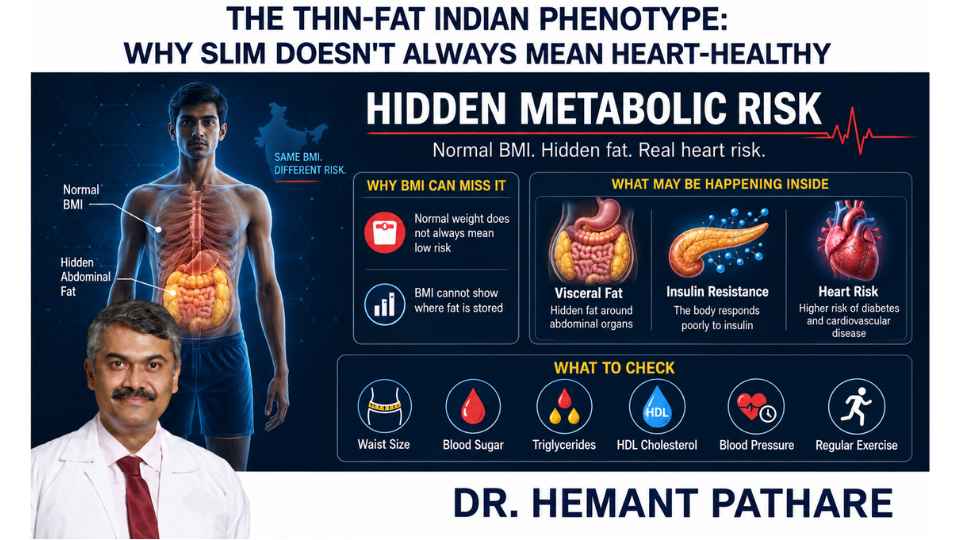
Research over several decades has shown that South Asians can carry more body fat, particularly metabolically harmful abdominal and visceral fat, at a lower BMI than many other populations. They can also develop insulin resistance, type 2 diabetes and cardiovascular disease without first becoming visibly obese.
This pattern has acquired an unusual but memorable name:
the “thin-fat” Indian phenotype.
The term is not meant to suggest that every thin Indian is metabolically unhealthy. Nor is it a diagnosis by itself.
It highlights something much more useful:
body weight and metabolic health are not always the same thing.
And when cardiovascular risk is being assessed, that distinction matters.
Why BMI Can Miss Part of the Picture
BMI is a convenient calculation.
Weight (in kilograms) is divided by height (in metres) squared.
It is useful for studying populations and provides a quick indication of whether someone is carrying excess weight. But BMI cannot answer several important questions.
It cannot distinguish muscle from fat.
It cannot tell where fat is stored.
And two people with exactly the same BMI can have very different amounts of body fat and very different metabolic risk.
This was demonstrated memorably more than two decades ago in what became known as the Y-Y paradox.
Indian diabetes researcher Dr Chittaranjan Yajnik and British researcher Professor John Yudkin had almost identical BMIs—around 22.3 kg/m². Yet measurements showed substantially more body fat in Dr Yajnik.
Their outward body size looked similar on paper.
Their body composition was not.
The comparison, published in The Lancet in 2004, helped draw attention to a characteristic that subsequent research has continued to explore in South Asians.
The important question therefore becomes not simply:
How much does a person weigh?
but also:
What is that weight made of, and where is the fat located?
All Body Fat Is Not Metabolically Equal
Fat stored immediately under the skin is called subcutaneous fat.
Fat stored deeper inside the abdomen, surrounding organs such as the liver and intestines, is known as visceral fat.
The distinction matters.
Visceral fat is metabolically active. Excess accumulation is strongly associated with insulin resistance, abnormal cholesterol and triglycerides, inflammation, high blood pressure and cardiovascular risk. Abdominal and visceral adiposity can predict cardiovascular risk even when BMI itself does not classify someone as obese.
South Asians tend to have proportionately greater body fat and visceral adiposity at a given BMI, along with relatively less lean mass in many populations studied.
Fat may also begin accumulating where it was never intended to be stored in large quantities—such as the liver and around or within other organs. This is called ectopic fat.
One explanation being studied is that some individuals have a lower capacity to safely expand the subcutaneous fat stores beneath the skin. Once that storage capacity is exceeded, more fat may accumulate centrally and in ectopic locations.
The result is an important paradox:
a person does not need to look very heavy to be carrying metabolically harmful fat.
From Visceral Fat to Insulin Resistance
This is where the connection with diabetes becomes clearer.
Normally, insulin helps glucose move from the bloodstream into cells where it can be used for energy.
With insulin resistance, tissues respond less effectively to insulin. The pancreas initially compensates by producing more of it.
For some time, blood glucose may remain reasonably normal.
But the metabolic environment has already begun changing.
Insulin resistance commonly travels with a cluster of abnormalities: increased triglycerides, lower HDL or “good” cholesterol, increasing blood pressure, abdominal fat and eventually impaired glucose regulation.
Over time, the pancreas may no longer be able to compensate sufficiently, and blood glucose begins to rise.
Prediabetes and then type 2 diabetes can follow.
This helps explain why waiting for obvious obesity—or even waiting for diabetes itself—to appear can miss an earlier period of cardiovascular risk.
The metabolism may have been changing long before the weighing scale became alarming.
Why the Heart Cares About Where Fat Is Stored
Cardiovascular risk cannot be assessed just by observing a persons’s appearance.
The coronary arteries are affected by what is happening within the circulation.
Insulin resistance, diabetes, high blood pressure, elevated triglycerides, abnormal cholesterol and chronic metabolic inflammation all contribute, directly or indirectly, to the conditions in which atherosclerosis develops.
Atherosclerosis is the gradual accumulation of cholesterol-rich plaque within arterial walls.
As plaque builds, coronary arteries can narrow and restrict blood flow to the heart muscle. If a vulnerable plaque ruptures and triggers formation of a clot, the artery may suddenly become blocked, causing a heart attack.
For South Asians, the concern is particularly relevant because studies consistently show a higher burden of type 2 diabetes and cardiovascular disease at comparatively lower BMI levels. South Asian ancestry itself is recognised in cardiovascular guidance as a factor that can enhance a person’s estimated cardiovascular risk.
Once diabetes develops, another layer is added.
Diabetes will accelerate atherosclerosis, and coronary disease will become more extensive. Kidney disease, hypertension and disease in arteries elsewhere in the body may coexist.
This becomes particularly important when coronary disease has progressed far enough for revascularisation or cardiac surgery to be considered.
At that stage, the patient’s BMI is only one small piece of information.
The coronary anatomy matters.
So does heart function.
Kidney function matters.
The presence and duration of diabetes matter.
Peripheral circulation matters.
Muscle mass and overall physical reserve matter.
And the combination of these factors may influence both treatment decisions and recovery.
A normal BMI therefore cannot be interpreted as a certificate of cardiovascular protection.
This Is Not Just a Theoretical Indian Phenomenon
Recent Indian data make the issue particularly difficult to dismiss.
A 2025 analysis from the nationwide ICMR-INDIAB study, which included more than 113,000 adults across Indian states and Union Territories, examined metabolic health alongside obesity.
Researchers classified participants using BMI together with abnormalities such as abdominal obesity, high blood pressure, elevated glucose, high triglycerides and low HDL cholesterol.
One striking group was described as metabolically obese but non-obese—people who were not obese according to the BMI criterion but nevertheless carried significant metabolic abnormalities.
This group represented 43.3% of participants in the study’s classification and was even more prevalent in rural than urban participants.
That statistic needs to be interpreted carefully: it does not mean that 43% of Indians are “thin-fat,” nor does it mean that all people with normal BMI have cardiovascular disease.
What it does demonstrate is that in a large Indian population, BMI alone failed to separate metabolic health from metabolic risk.
That is clinically much more important.
A Better Question Than “Am I Overweight?”
The thin-fat phenotype does not make BMI useless.
It means BMI should not be used alone.
For an Indian adult—particularly someone with a family history of diabetes or premature cardiovascular disease—a broader assessment can provide much more information.
Waist circumference gives an indication of central adiposity. Current Asian-specific clinical criteria use lower waist thresholds than those traditionally applied to Western populations; a waist of around 90 cm or more in men and 80 cm or more in women is commonly used as an indicator of increased abdominal adiposity in South Asians.
But waist size is still only one clue.
Blood pressure matters.
Fasting glucose and HbA1c matter.
Triglycerides, HDL and LDL cholesterol matter.
Physical activity and fitness matter.
Smoking matters.
Family history matters.
And depending on the individual, kidney function, fatty liver disease and other metabolic abnormalities may also contribute to the overall picture.
Recent obesity standards have increasingly moved in exactly this direction—combining BMI with waist measurements and evidence of metabolic or clinical consequences rather than allowing one weight-to-height calculation to define the patient’s health.
Slim Does Not Mean Sick Either
There is an equally important caution.
The thin-fat phenotype should not create a new assumption that every slim Indian is metabolically unhealthy.
Many people with a normal BMI have excellent metabolic health.
Similarly, not every person with a higher BMI has the same amount of visceral fat or the same cardiovascular risk.
The point is not to replace one visual stereotype with another.
It is to stop judging metabolic health primarily by appearance.
Genetics and early-life development may contribute to South Asian susceptibility, but so do modifiable influences such as diet quality, physical activity, sleep, smoking and the accumulation of abdominal fat over time.
Higher risk is not the same as predetermined disease.
It simply means that earlier recognition matters more.
The Number on the Scale Is Only the Beginning
For decades, the public conversation around metabolic health has centred heavily on weight.
Lose weight.
Avoid obesity.
Keep BMI normal.
These remain useful messages—but for South Asians they are incomplete.
Someone can be relatively slim and still develop insulin resistance.
A normal BMI can coexist with excess visceral fat.
Diabetes can appear before obvious obesity.
And cardiovascular risk can accumulate quietly while body weight remains reassuring.
The heart is not protected by how lean a person looks.
It is protected by what is happening to blood pressure, glucose metabolism, cholesterol, arteries, fitness and the broader metabolic system.
Perhaps the more useful question is therefore no longer:
“Is the weight normal?”
It should be:
“Is the metabolism healthy?”
And in a population as vulnerable to diabetes and premature cardiovascular disease as South Asians, learning to ask that second question earlier may matter far more than waiting for the weighing scale to provide a warning.
When you think about a “healthy weight”, do you still look mainly at BMI—or do waist size, blood pressure, glucose and cholesterol deserve equal attention?
