
❤️ Introduction
For decades, traditional cigarette smoking was recognized as one of the most significant preventable causes of cardiovascular disease.
Public awareness campaigns, stronger regulations, and increased health education successfully shifted perceptions around smoking and its dangers.
Yet as conventional tobacco use began to decline in many populations, a new trend emerged.
Electronic cigarettes, vaping devices, flavored nicotine products, and hookah culture have rapidly gained popularity—particularly among adolescents and young adults.
Marketed as “safer alternatives”, socially acceptable, and often perceived as modern lifestyle products, these forms of nicotine consumption have created an entirely new public health concern.
What is particularly worrying is that many users do not identify themselves as smokers at all.
Individuals who would never consider lighting a cigarette may regularly vape, use disposable nicotine devices, or participate in social hookah sessions without recognizing the cardiovascular risks involved.
The perception of reduced harm has unfortunately outpaced scientific understanding among the general public.
Increasing evidence now suggests that while these products differ from conventional cigarettes in delivery systems, they are not free from consequences.
The cardiovascular system remains highly vulnerable to nicotine exposure and associated toxins, particularly when use begins early and continues over time.
A new era of tobacco exposure has arrived—and the heart may be paying the price.
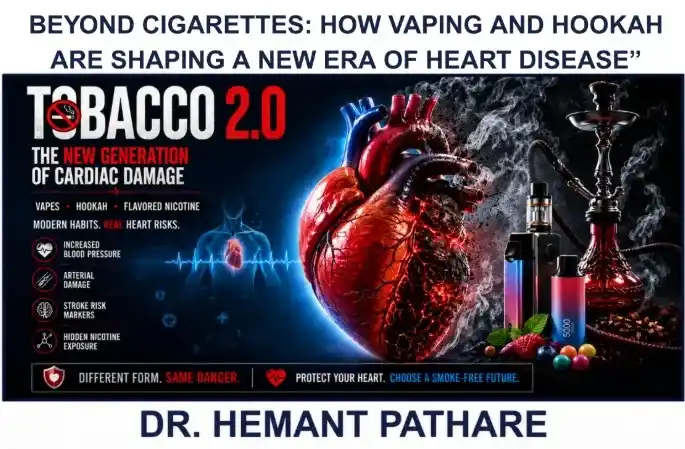
🚬 The Rise of Tobacco 2.0
Unlike previous generations, nicotine consumption today has become increasingly technology-driven and socially rebranded.
Modern tobacco exposure includes:
- Electronic cigarettes and vaping devices
- Disposable nicotine products
- Flavored e-cigarettes
- Hookah and waterpipe smoking
- Fruit and candy-flavored nicotine formulations
- Social nicotine use at gatherings and lounges
Several factors have contributed to this rise:
- Attractive flavors and packaging
- Strong social media visibility
- Perception of reduced harm
- Peer influence
- Ease of accessibility
- Marketing that frames vaping as a lifestyle trend rather than tobacco exposure
The result is a growing population of younger users exposed to nicotine earlier and more frequently than previous generations.
⚠️ The “Safer Alternative” Misconception
One of the biggest drivers behind vaping and hookah use is the widespread belief that they are significantly safer than cigarettes.
Many assumptions include:
- “It’s only vapor.”
- “Hookah smoke passes through water, so toxins are filtered.”
- “I only smoke socially.”
- “Vaping helps avoid smoking-related damage.”
However, nicotine itself remains biologically active regardless of the delivery mechanism.
The heart and blood vessels respond to nicotine exposure in powerful ways.
While the quantity and composition of toxins may differ from traditional smoking, exposure does not become harmless simply because the format changes.
❤️ How Nicotine Affects the Heart
Nicotine influences the cardiovascular system almost immediately after entering the body.
Its effects include:
- Increased blood pressure
- Elevated heart rate
- Constriction of blood vessels
- Increased inflammatory activity
- Heightened stress hormone release
- Greater strain on the cardiovascular system
Repeated exposure over time may contribute to:
- Endothelial dysfunction
- Accelerated plaque formation
- Reduced vascular flexibility
- Increased risk of hypertension
- Elevated cardiovascular stress
Even in younger individuals, these physiological changes may begin long before symptoms become apparent.
The concern is not only immediate effects—but cumulative damage over years of exposure.
💨 Vaping and Emerging Cardiac Concerns
Research surrounding e-cigarettes continues to evolve, but several findings have raised concern.
Emerging studies suggest associations between vaping and:
- Increased arterial stiffness
- Endothelial injury
- Impaired blood vessel function
- Increased oxidative stress
- Elevated stroke risk markers
- Systemic inflammation
Some aerosols generated during vaping may also contain:
- Heavy metals
- Ultrafine particles
- Chemical flavoring compounds
- Volatile organic substances
Although long-term outcomes continue to be studied, early evidence suggests that cardiovascular effects cannot be ignored.
🌙 Hookah: Social Tradition, Hidden Risks
Hookah often carries a different social perception than cigarettes.
Because it is frequently associated with gatherings, cafés, and occasional use, many users underestimate its potential harm.
However, several misconceptions exist.
A single prolonged hookah session may expose users to substantial amounts of smoke and toxins depending on duration and frequency.
Potential exposures include:
- Carbon monoxide
- Charcoal combustion byproducts
- Toxic chemicals
- Fine particulate matter
- Nicotine exposure
Water filtration does not eliminate many harmful substances.
The heart remains exposed.
👥 Why Younger Populations Face Greater Risk
One of the most concerning aspects of Tobacco 2.0 is the age at which exposure begins.
Younger individuals increasingly encounter nicotine through:
- Social media trends
- Peer environments
- Flavored products
- Attractive branding
- Casual experimentation
Early exposure may create long-term patterns of nicotine dependence and prolonged cardiovascular stress.
Additionally, many younger individuals often lack:
- Preventive health screenings
- Cardiovascular risk assessments
- Awareness of early warning signs
The concern is not simply present-day use—it is the possibility of decades of cumulative exposure ahead.
🛡️ Prevention and Awareness Matter
Cardiovascular disease frequently develops silently.
Waiting for symptoms before taking action may delay opportunities for prevention.
Awareness efforts should prioritize:
- Education regarding vaping and hookah risks
- Early conversations among adolescents and families
- Public health initiatives
- Nicotine cessation support
- Screening for cardiovascular risk factors
- Greater understanding of long-term consequences
Reducing nicotine-related harm begins with recognizing that “new” does not always mean safer.
❤️ Closing Thought
The evolution of tobacco use has not reduced its relevance in modern disease—it has only changed its appearance.
What was once a clearly identifiable habit with visible health warnings has now transformed into a more subtle, socially acceptable, and technologically packaged form of nicotine consumption.
Vapes, hookah, and flavored nicotine products have successfully rebranded tobacco for a new generation, often removing the psychological barriers that once discouraged early initiation.
But the human cardiovascular system has not evolved at the same pace as marketing narratives.
The heart and blood vessels respond to nicotine and toxic exposure in consistent biological ways, regardless of whether it is delivered through a cigarette, a vape, or a hookah pipe.
This is where the disconnect becomes most dangerous—not in the product itself, but in the perception surrounding it.
The greatest challenge today is not only clinical, but informational.
Many users genuinely believe they are making a safer choice, or that occasional use does not carry meaningful risk.
This normalization delays awareness, reduces urgency for cessation, and often allows long-term exposure to go unrecognized until disease manifests.
At the same time, the rising burden of cardiovascular disease in younger populations adds a layer of concern that cannot be ignored.
Ultimately, Tobacco 2.0 is not just a shift in product design—it is a shift in perception.
And perception shapes behavior more powerfully than warnings.
As cardiothoracic practice advances through minimally invasive procedures, robotic surgery, and improved critical care outcomes, the most impactful progress will still remain prevention.
Because no surgical innovation can fully offset years of preventable vascular injury.
The goal is not only to treat advanced cardiac disease more effectively—but to ensure fewer individuals reach that stage in the first place.
In that sense, the true fight against modern tobacco is no longer confined to hospitals or operating rooms.
It begins much earlier—in awareness, education, and the ability to recognize that “new” does not always mean “safe.”
The future of cardiac health will depend not just on how well we operate on diseased hearts, but on how effectively we protect healthy ones before damage begins.