
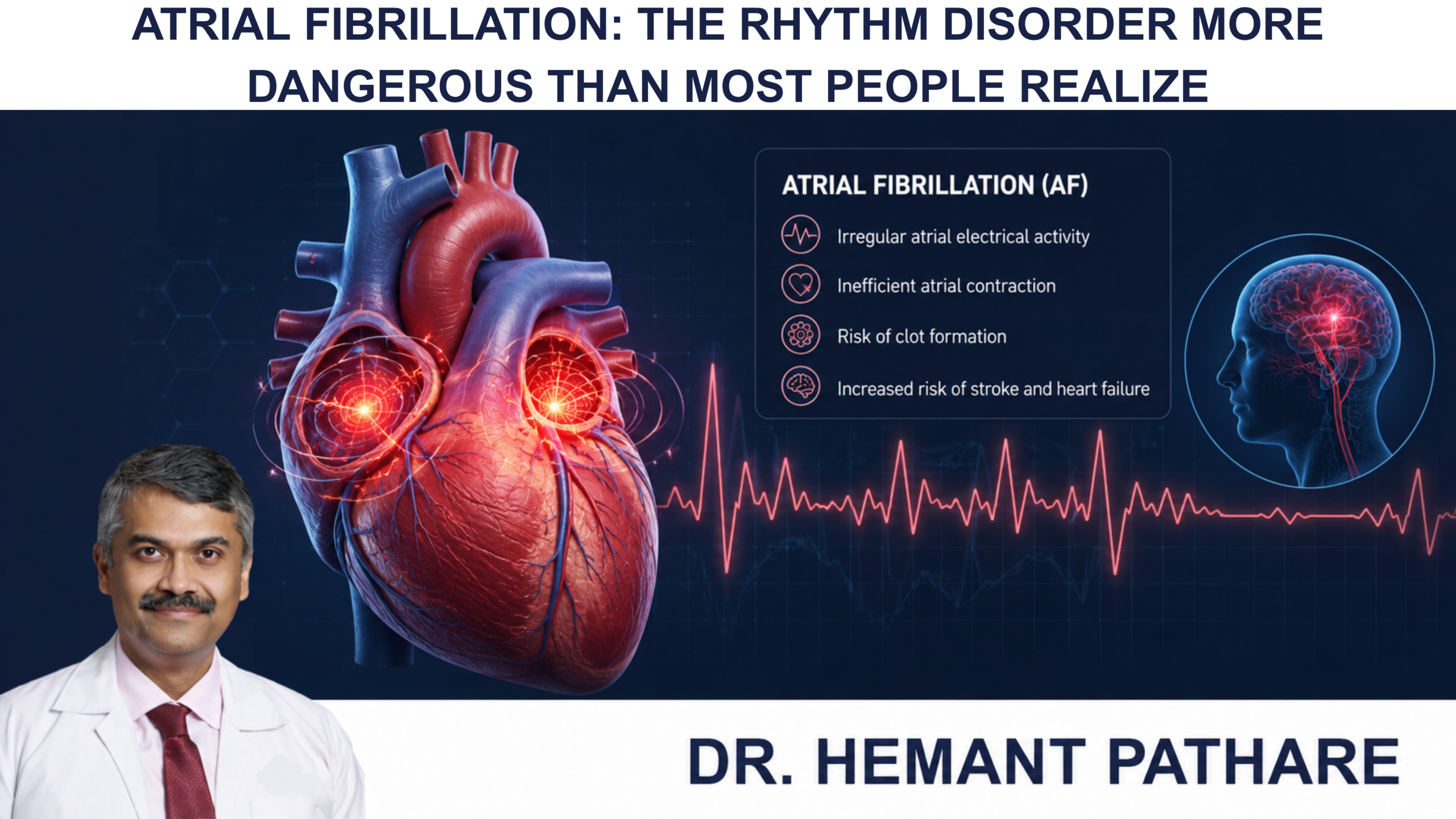
Understanding Atrial Fibrillation and Its Growing Impact
on Cardiovascular Health
Introduction
Heart disease is often associated with blocked arteries, heart attacks, and heart failure. Yet
one of the most common and potentially dangerous cardiovascular conditions receives far
less public attention despite affecting millions of people worldwide: Atrial Fibrillation (AF).
AF is the most common sustained heart rhythm disorder encountered in clinical practice. It
occurs when the upper chambers of the heart—the atria—beat rapidly and irregularly,
disrupting the heart's normal electrical activity. While some individuals experience noticeable
symptoms such as palpitations or breathlessness, many remain completely unaware that they
have the condition until a serious complication occurs .It used to be extremely common in the
era of Rheumatic heart disease especially with severe mitral valve stenosis.
What makes AF particularly concerning is its strong association with stroke. In fact, patients
with atrial fibrillation are significantly more likely to suffer a stroke than those with a normal
heart rhythm. Many of these strokes are severe, disabling, and potentially preventable with
early diagnosis and appropriate treatment.
As populations age and lifestyle-related risk factors continue to rise, atrial fibrillation is
becoming increasingly common across the world. At the same time, advances in monitoring
technologies, medications, and catheter-based therapies are transforming how the condition is
detected and managed. Understanding this evolving landscape has become essential for both
healthcare professionals and patients alike.
What Exactly Is Atrial Fibrillation?
Under normal circumstances, the heart beats in a coordinated rhythm controlled by precise
electrical signals.
In atrial fibrillation, these electrical signals become chaotic. Instead of contracting in an
organized manner, the atria quiver rapidly and irregularly.
This can result in:
• Irregular heartbeat
• very rapid pulse rate
• Reduced overall pumping efficiency by upto 20%
• Blood stagnating pooling within the atria
• Increased risk of clot formation
Some episodes may last minutes, while others can persist for days, months, or become
permanent.
Why Is AF Becoming More Common?
The rising prevalence of atrial fibrillation is closely linked to demographic and lifestyle
changes occurring globally.
Aging Populations
Age remains one of the strongest risk factors for AF. As life expectancy increases, the
number of individuals living with atrial fibrillation continues to grow especially over the age
of 75 years.
Obesity and Metabolic Disease
Obesity, diabetes, and metabolic syndrome contribute significantly to structural and electrical
changes within the heart, increasing susceptibility to rhythm disorders.
Hypertension
Long-standing high blood pressure can enlarge and remodel the atria, creating conditions that
favor the development of AF.
Sleep Apnea
Growing recognition of sleep-disordered breathing has revealed a strong association between
obstructive sleep apnea and atrial fibrillation.
Lifestyle Factors
Excessive alcohol consumption, smoking, chronic stress, and sedentary lifestyles may also
contribute to the increasing burden of AF.
Why Is Atrial Fibrillation Potentially Dangerous?
Many people assume that an irregular heartbeat is merely an inconvenience. In reality, AF
can have serious consequences if left untreated.
Stroke Risk
The most significant complication of atrial fibrillation is stroke.
Because blood may stagnate within the atria, clots can form and subsequently travel to the
brain, blocking blood flow and causing a stroke.
AF-related strokes are often:
• More severe
• More disabling
• Associated with higher mortality rates
In many patients, a stroke becomes the first indication that atrial fibrillation was present.
Heart Failure
Persistent rapid heart rates can weaken the heart muscle over time and contribute to the
development or worsening of heart failure.
Recurrent Hospitalizations
Patients with uncontrolled AF frequently experience repeated hospital admissions due to
symptoms, complications, or associated cardiovascular conditions.
The Challenge of Silent Atrial Fibrillation
One of the most concerning aspects of AF is that many patients experience few or no
symptoms. Some have paroxysmal AF i.e. it comes and goes.
Some individuals discover the condition only during:
• Routine health check-ups
• Preoperative evaluations
• Smartwatch notifications
• Stroke investigations
This phenomenon, often referred to as “silent AF,” highlights the importance of early
detection and regular cardiovascular assessment, particularly among higher-risk individuals.
How Treatment Strategies Are Evolving
Management of atrial fibrillation has advanced significantly over the past decade.
Better Stroke Prevention
Modern anticoagulant medications have transformed stroke prevention.
Compared to older therapies like Nicoumalone or warfarin , newer oral anticoagulants eg
Dabigatran and Apixaban. offer effective protection with fewer monitoring requirements and
greater convenience for many patients.
Rhythm Control Strategies
Historically, treatment often focused primarily on controlling heart rate.
Today, increasing evidence supports earlier rhythm-control strategies in selected patients to
improve symptoms and potentially reduce long-term complications.
Catheter Ablation
Catheter ablation has emerged as one of the most important advances in AF management.
Using specialized catheters threaded into the veins of the heart (Coronary Sinus), physicians
can identify and eliminate abnormal electrical pathways responsible for triggering atrial
fibrillation.
For many carefully selected patients, ablation offers:
• Improved symptom control
• Reduced AF recurrence
• Better quality of life
Wearable Technology
Smart watches and wearable cardiac monitoring devices are revolutionizing early detection.
Many patients are now diagnosed through irregular rhythm alerts generated by consumer
health technology before significant complications develop.
The Future of AF Management
Research continues to explore innovative approaches to preventing and treating atrial
fibrillation.
Emerging areas of interest include:
• Artificial intelligence-assisted rhythm monitoring
• Advanced imaging-guided treatment planning
• Personalized risk prediction models
• Earlier intervention strategies
• Novel anti-arrhythmic therapies
As these developments progress, AF management is becoming increasingly individualized
and proactive.
Final Thoughts
Atrial fibrillation may not attract the same public attention as heart attacks or bypass surgery,
but its impact on cardiovascular health is profound. It is a condition that often develops
quietly, progresses gradually, and may remain undetected until a serious complication occurs.
The encouraging reality is that many of the risks associated with AF—particularly
stroke—can be significantly reduced through timely diagnosis and appropriate treatment.
Advances in medications, catheter-based therapies, and digital health technologies are
making it easier than ever to identify patients early and intervene effectively.
As awareness grows, the conversation surrounding atrial fibrillation is shifting from simply
managing symptoms to preventing complications before they occur. For patients, clinicians,
and healthcare systems alike, that shift represents one of the most important opportunities in
modern cardiovascular medicine.
The rhythm of the heart may be invisible, but when it becomes irregular, the consequences
can be life-changing. Recognizing atrial fibrillation early may be one of the most powerful
steps we can take toward preventing stroke, preserving heart health, and improving long-term
quality of life.