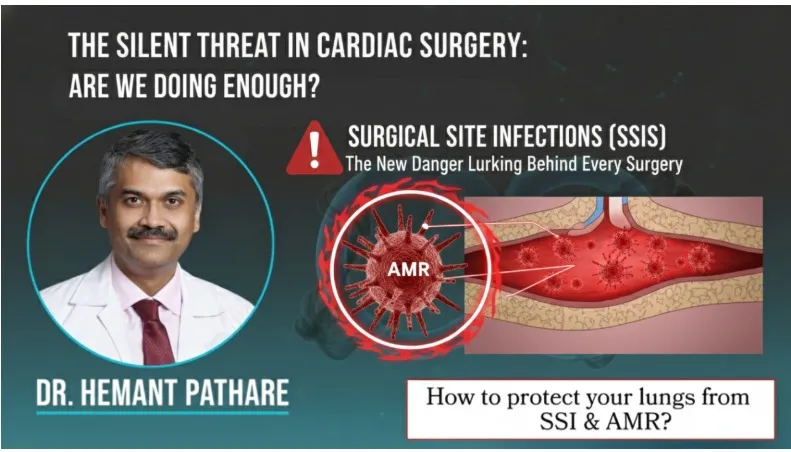
⚠️ AMR: The New Danger Lurking Behind Every Surgery
Today, 8 out of 10 patients coming for elective surgeries already harbour drug-resistant bacteria. This forces surgeons to use reserved, very expensive, last-line antibiotics just to prevent or treat infections that were once easily manageable.
Antimicrobial resistance (AMR) is not a future threat — it’s here, and it’s accelerating.
AMR occurs when bacteria, viruses, fungi and parasites no longer respond to routinely used antimicrobial agents. As a result the antibiotics become ineffective and infections become difficult to treat, increasing the risk of disease spread, severe illness and death.
AMR threatens decades of medical progress.
It affects people, animals, plants, and entire ecosystems.
Antibiotics that once cured common infections are rapidly losing effectiveness.
AMR is already responsible for over 1 million deaths every year, with the number expected to continue rising.
This year’s WHO theme — “Act Now: Protect Our Present, Secure Our Future” — calls for:
✅ Stronger surveillance
✅ Better access to quality medicines
✅ Enhanced diagnostics
✅ More innovation
✅ Resilient health and food systems
World AMR Awareness Week is a reminder that protecting antimicrobials is a shared global responsibility. When people have limited access to prevention, diagnostics and appropriate treatment, drug-resistant infections thrive.
🩺 The Silent Threat in Cardiac Surgery: Are We Doing Enough to Stop Surgical Site Infections (SSIs)?
Every year, thousands of cardiac patients undergo life-saving surgeries. But what happens when the procedure meant to save a life becomes the very reason their recovery is threatened?
Welcome to this week’s edition of The Healthcare Intelligence Digest, where we unpack one of the most underestimated yet deadly challenges in surgical medicine: Surgical Site Infections (SSIs) — especially the ones that occur after cardiac surgery.
💡 Why This Matters
Surgical site infections are not just complications — they are costly, life-threatening, and often preventable.
Up to 10–20% of major surgeries end in SSI.
In cardiac surgery, the risk is even higher: 3.5% to nearly 27%, depending on patient condition and procedure type.
SSIs contribute to longer hospital stays, repeat surgeries, increased mortality (3% to 20%), and massive financial burden on healthcare systems worldwide.
In cardiac surgery, where the incision lies millimeters away from critical organs, the stakes are even higher.
🔍 Understanding SSIs: What Really Happens?
What qualifies as an SSI?
According to CDC guidelines:
Superficial SSI: Within 30 days, involves skin and subcutaneous tissue.
Deep SSI: Within 30–90 days, involves fascia, muscle, or sternum.
Organ/space SSI: The most serious — including mediastinitis, a life-threatening infection of the space around the heart.
In Cardiac Surgery, the Most Common Culprits Are:
Sternal wound infections (superficial or deep)
Graft harvesting site infections
Mediastinitis (one of the most devastating post-operative complications)
Symptoms may begin subtly — redness, exudate, or pain — but can rapidly escalate to sternal instability, sepsis, or shock, especially in deep infections.
📊 Epidemiology: The Numbers Tell a Story
Deep sternal wound infection (DSWI): 1–5% incidence
Mortality in mediastinitis: up to 20%, sometimes 50% in severe cases
Average hospital stay increases by ~9.7 days
Annual cost burden (USA): Over $700 million
Despite decades of improvement, the mortality rate hasn’t changed significantly. Why? Because today’s cardiac patients are older, more complex, and carry heavier comorbidity loads.
⚠️ Who Is Most at Risk?
Major Preoperative Risk Factors
Diabetes
Obesity
COPD
Renal failure
Smoking
Peripheral vascular disease
Hypoalbuminemia
S. aureus nasal carriage
Prolonged hospital stay pre-surgery
Intraoperative Risks
Long procedure duration
Cardiopulmonary bypass time
Emergency operation
Bilateral mammary artery harvesting
Postoperative Risks
Respiratory failure
Need for inotropic support
Long ICU stay
Three factors stand out as the strongest predictors:
➡️ S. aureus carriage
➡️ Obesity
➡️ Poor glucose control
🔬 How Infections Happen: The Science Behind SSIs
Even though cardiac surgery is considered a “clean” procedure, contamination is almost unavoidable.
Up to 80% of S. aureus SSIs originate from the patient’s own microbiome.
Surgical materials (sutures, sponges, synthetic implants) further increase infection risk.
The inflammatory immune suppression caused by cardiopulmonary bypass decreases early resistance to pathogens.
🦠 What Organisms Are Responsible?
Most Common Pathogens:
Staphylococcus aureus (40–60%)
Coagulase-negative staphylococci (20–30%)
Gram-negative organisms (20–40%):
E. coli, Klebsiella, Serratia, Pseudomonas
Rare but Serious:
Candida spp.
Polymicrobial infections (20–44% of cases)
🧪 Diagnosing SSIs: Where Precision Matters
Diagnosis involves:
Clinical symptoms
Microbiology (wound swabs, aspirates, blood cultures)
Diagnostic imaging
CT scan remains the gold standard for deep infections and mediastinitis — particularly effective after day 14 post-surgery when post-op fluid/gas naturally resolves.
🛡️ Prevention: The Most Powerful Tool We Have
1️⃣ Preoperative Optimization
Control blood sugar (<180 mg/dL perioperatively)
Improve nutrition (target albumin >2.5 g/mL)
Treat all existing infections
Encourage smoking cessation ≥30 days before surgery
2️⃣ Staphylococcus aureus Decolonization
A MUST for carriers:
Nasal mupirocin (2–3 times/day, 4–7 days)
Chlorhexidine baths
Decolonization significantly reduces SSI risk — especially for sternal wound infections.
3️⃣ Perioperative Antibiotic Prophylaxis (PAP)
Cefazolin is first choice
Add vancomycin for MRSA risk
Re-dose during long surgeries or significant blood loss
Do not continue prophylaxis beyond 24 hours
4️⃣ Optimal Surgical Site Preparation
No shaving — use clippers, only if needed
Prefer alcohol-based chlorhexidine for skin preparation
5️⃣ NPWT (Negative Pressure Wound Therapy)
A game-changer for both prevention and treatment.
Reduces wound tension
Improves perfusion
Prevents contamination
Reduces the incidence of deep and superficial SSIs
6️⃣ Gentamicin-Impregnated Collagen Sponges (GICS)
Though evidence is still evolving, many studies support its role in reducing DSWI in high-risk patients.
🧯 Treatment: When Infection Strikes
Management involves:
Surgical Intervention
Removal of infected tissue
Drainage of mediastinum
Sternal stabilization techniques
NPWT for ongoing care
Antibiotic Therapy
Empirical therapy for unstable patients
Tailored therapy once microbiology results are available
Deep infections: 4–6 weeks, with at least 2–3 weeks IV
Superficial infections: 3–4 weeks total
🏁 Final Thoughts: This Battle Is Winnable
SSIs in cardiac surgery are not just medical events — they are life-altering complications that burden patients, families, healthcare teams, and global health systems.
But with the right combination of:
✨ Preoperative optimization
✨ Decolonization protocols
✨ Evidence-based antibiotic prophylaxis
✨ Advanced wound management technologies (NPWT, GICS)
✨ Strict surgical discipline
—we can drastically reduce their occurrence and protect the lives we work so hard to save.