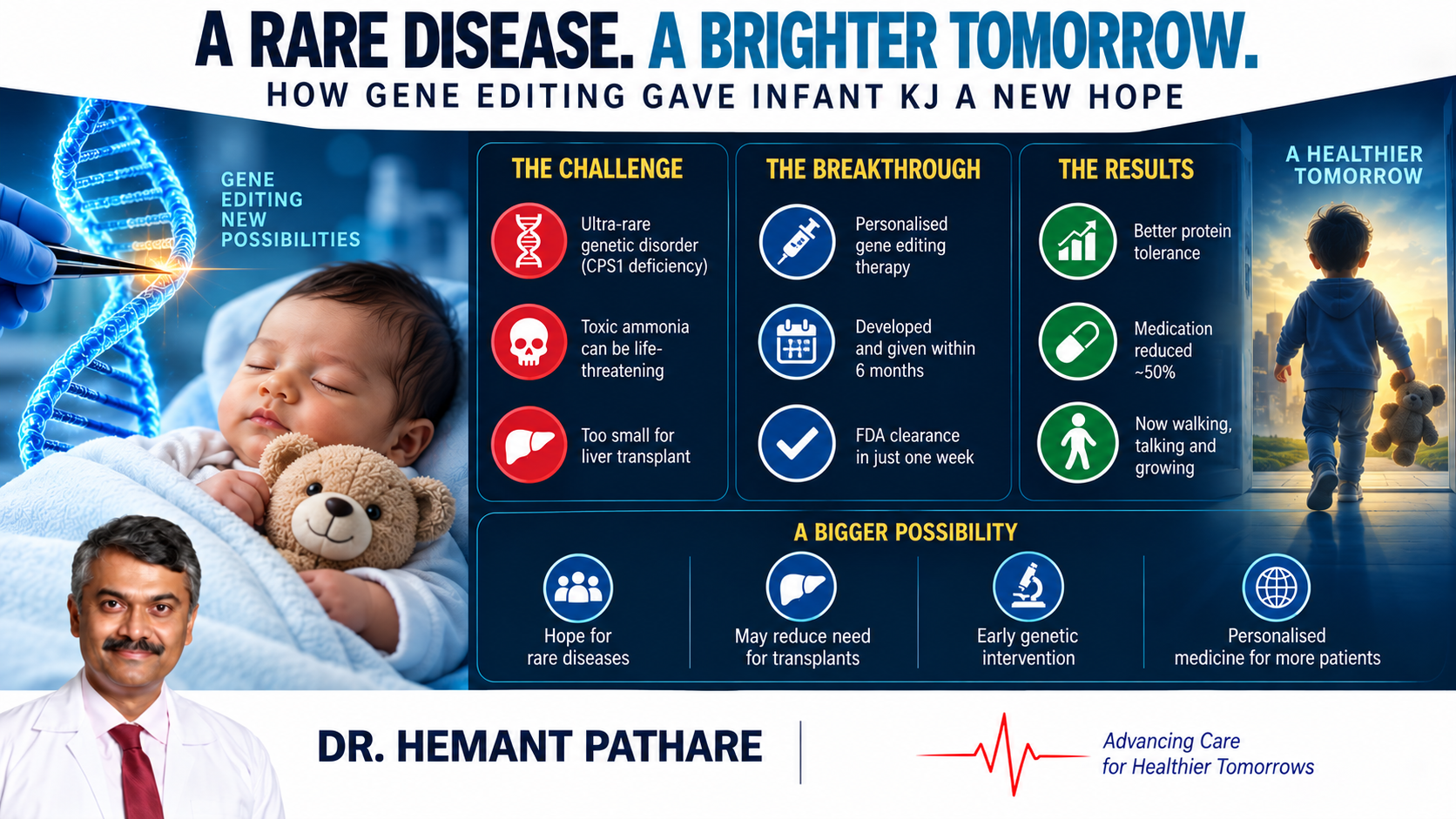
An infant KJ was born with an ultra-rare genetic disorder – CPS1 (carbamoyl phosphate synthetase 1 ) deficiency, that affects one in every 1.3 million births and carries a mortality rate of about 50% in early infancy. CPS1 is the first enzyme in the urea cycle,thus its deficiency interferes with the Urea cycle and so toxic blood ammonia levels develop , causing seizures, coma, permanent brain damage and death.For severe CPS1 deficiency, liver transplantation was the only established treatment because a donor liver can provide functioning cells that carry out the missing metabolic process. The neonate infant was too small and unstable to undergo such major surgery.
The team of doctors and researchers had roughly six months to play GOD – they designed the editor package for correcting the mutated gene, then manufactured it to clinical-grade standards and carried out safety testing in animal models.
When they submitted their request to the U.S. Food and Drug Administration, clearance came within a week although there was still no human trial of this gene CRISPR therapy for this disease.No randomised control trials – no data.
On February 25, 2025, at around seven months old, KJ received his first infusion cautiously.Two more doses followed over the next two months, with the team monitoring him closely and gradually increasing the dose.No major safety problems emerged.
Then came the real test: what would happen to KJ?
The First Signs of Change
The results appeared gradually.Within the first 10 days, KJ was able to tolerate significantly more protein in his diet — a sign that his urea cycle was handling more of the work.His need for ammonia-scavenging medication fell by roughly half.
Then came an important real-world test. Infections can trigger dangerous ammonia spikes in children with CPS1 deficiency. KJ went on to experience common childhood infections, but his ammonia levels did not show the dangerous surges doctors had feared.His body was handling situations that could previously have become life-threatening.
After 307 days at the paediatric hospital, KJ was finally discharged.
One Year Later
By February 2026, one year after his first infusion, KJ was walking, talking and continuing to grow. He still follows a modified diet and takes daily medication. His underlying genetic condition remains, and he continues to require long-term monitoring. But the immediate threat that had surrounded him from his first days of life had changed dramatically.The treatment had not erased his disease. It had given his own liver enough restored function to manage a process it could barely perform before.
And that is what makes KJ’s case significant beyond the individual result.
What KJ’s Treatment Could Mean
KJ’s case was published in the New England Journal of Medicine. Later in 2025, Nature named him among its ten people who shaped science that year — making him the first infant, and the first patient rather than a researcher, to appear on the list.
But the significance of his treatment goes beyond recognition.
For inherited disorders that affect the liver, correcting the genetic defect early enough could one day change how doctors approach organ failure. Instead of waiting for irreversible damage, there may be an opportunity to intervene at the molecular level — potentially reducing or delaying the need for transplantation in some patients.
KJ’s treatment is still a single case, and questions around long-term safety, durability, manufacturing and access remain. But it has shown that a therapy can be developed around a patient’s specific genetic mutation and delivered within the narrow window when it can make a difference.
For people living with ultra-rare genetic diseases, that opens a new possibility: their condition may be rare, but their treatment does not have to be out of reach simply because there are so few patients like them.
And perhaps that is the most important shift KJ’s story represents.
Medicine has long learned how to replace what the body can no longer do. Now, it is beginning to explore how to repair the genetic errors that made it fail in the first place.
For inherited disorders that affect the liver, correcting the genetic defect early enough could one day change how doctors approach organ failure. Instead of waiting for irreversible damage, there may be an opportunity to intervene at the molecular level — potentially reducing or delaying the need for transplantation in some patients.
KJ’s treatment is still a single case, and questions around long-term safety, durability, manufacturing and access remain. But it has shown that a therapy can be developed around a patient’s specific genetic mutation and delivered within the narrow window when it can make a difference. For people living with ultra-rare genetic diseases, that opens a new possibility.
Medicine has long learned how to replace what the body can no longer do. Now, it is beginning to explore how to repair the genetic errors that made it fail in the first place.
