
🩺 INTRODUCTION
In cardiovascular medicine, success is no longer measured simply by opening a blocked artery or creating a bypass. Increasingly, it is defined by how completely we restore blood flow to the heart and how thoughtfully we tailor that strategy to each individual patient.
For decades, the primary objective of coronary revascularization was straightforward: relieve symptoms, improve blood flow, and reduce the risk of future cardiac events.
Today, the conversation has evolved.
Cardiac surgeons and interventional cardiologists are no longer asking only, “Can we restore blood flow?” They are asking a more important question:
“Have we restored blood flow as completely and effectively as possible?”
This shift has placed complete revascularization at the center of modern coronary artery disease management.
❤️ WHAT DOES COMPLETE REVASCULARIZATION MEAN?
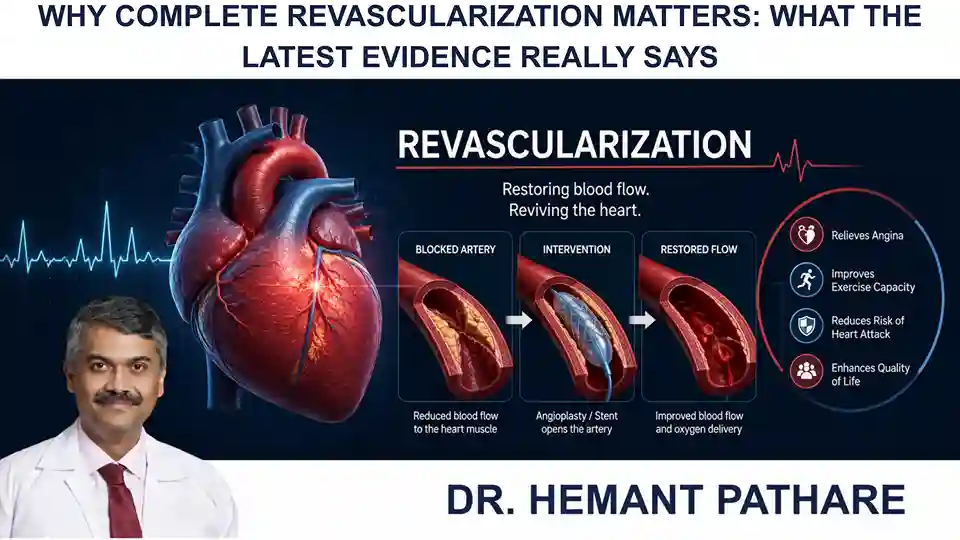
Complete revascularization refers to restoring adequate blood flow to all significantly diseased coronary arteries that supply viable myocardium, rather than treating only the artery responsible for the immediate clinical presentation.
At first glance, the concept appears simple.
In practice, however, determining what truly constitutes “complete” revascularization is one of the most nuanced decisions in cardiovascular medicine.
Every patient presents with unique coronary anatomy, varying degrees of myocardial viability, coexisting medical conditions, and different long-term goals. Consequently, achieving complete revascularization is not always about treating every visible narrowing, but about treating the lesions that are most likely to improve survival, preserve cardiac function, and enhance quality of life.
🎯 WHY IT MATTERS
Coronary artery disease is rarely confined to a single vessel.
Most Indian patients present with multivessel disease, diffuse atherosclerosis, or complex coronary anatomy, where untreated lesions may continue to compromise myocardial perfusion long after the initial procedure.
Growing evidence suggests that, in appropriately selected patients, complete revascularization is associated with:
- Lower rates of recurrent myocardial infarction
- Reduced need for repeat revascularization
- Improved long-term survival in selected populations
- Better symptom relief and functional capacity
- Enhanced long-term quality of life
These benefits are particularly relevant in patients with diabetes, left main coronary artery disease, and extensive multivessel disease, where comprehensive restoration of coronary blood flow often provides more durable outcomes.
⚖️ COMPLETE DOES NOT ALWAYS MEAN AGGRESSIVE
One of the most important misconceptions is that complete revascularization means treating every coronary narrowing.
Modern cardiovascular care recognizes that anatomy alone does not determine treatment. The physiological significance of a lesion, myocardial viability, ventricular function, patient frailty, surgical risk, and life expectancy all influence decision-making.
In some cases, leaving a lesion untreated may represent the most appropriate evidence-based strategy.
True complete revascularization is therefore not simply anatomical. It is functional, individualized, and guided by careful clinical judgment.
📚 EVIDENCE IS DRIVING THE CONVERSATION
Over the past decade, multiple clinical trials and guideline updates have strengthened the role of complete revascularization in carefully selected patients.
Studies involving both surgical and percutaneous approaches have demonstrated that addressing significant residual coronary disease can reduce future cardiovascular events and improve long-term outcomes compared with culprit-only treatment in appropriate clinical settings.
At the same time, research continues to emphasize that treatment strategies should never be based solely on angiographic appearances.
Modern decision-making increasingly integrates coronary physiology, intravascular imaging, myocardial viability assessment, and multidisciplinary Heart Team discussions to determine the most appropriate revascularization strategy for each patient.
Evidence has shifted the focus from treating arteries to treating patients.
🫀 SURGERY, PCI, OR BOTH?
Complete revascularization is no longer viewed through the lens of a single procedure.
For some patients, Coronary Artery Bypass Grafting (CABG) offers the most durable pathway to complete myocardial revascularization, particularly in complex multivessel disease.
For others, Percutaneous Coronary Intervention (PCI) provides excellent outcomes with less invasive treatment.
Increasingly, Hybrid Coronary Revascularization combines the strengths of both approaches, using surgical bypass for critical vessels such as the left anterior descending artery while treating selected lesions with PCI.
Rather than asking which treatment is superior, modern cardiovascular medicine asks which strategy best serves the individual patient.
🤝 THE HEART TEAM ADVANTAGE
Perhaps one of the greatest advances in coronary care is the growing emphasis on collaborative decision-making.
Today, complex revascularization strategies often emerge from discussions between cardiac surgeons, interventional cardiologists, cardiac imaging specialists, and heart failure physicians.
Each perspective contributes to a more comprehensive understanding of coronary anatomy, patient risk, procedural feasibility, and long-term outcomes.
This multidisciplinary approach ensures that treatment decisions extend beyond technical success to focus on what matters most: achieving the best possible result for the patient.
🚀 LOOKING AHEAD
The future of complete revascularization will be shaped by technologies that allow us to understand coronary disease with even greater precision.
Artificial intelligence, computational coronary physiology, advanced intravascular imaging, three-dimensional planning, and precision medicine are expected to further refine patient selection and procedural strategy.
The question will no longer be simply whether complete revascularization should be performed.
It will increasingly become: What is the most intelligent, safest, and most durable way to achieve it?
💭 FINAL THOUGHT
Complete revascularization represents far more than a technical objective. It reflects a philosophy of care that combines evidence, surgical judgment, patient-centered decision-making, and long-term thinking.
Every coronary artery tells only part of the story. The true goal is restoring the heart’s ability to function as a whole while respecting each patient’s unique anatomy, physiology, and future.
As cardiovascular medicine continues to evolve, success will not be measured by the number of arteries treated, but by the quality of the life those treatments help preserve.
❓ A QUESTION WORTH REFLECTING ON
As evidence increasingly supports complete revascularization in appropriately selected patients, should the future of coronary care focus less on treating individual blockages and more on restoring the heart as an integrated, functioning organ?
Perhaps the greatest evolution in coronary revascularization is not simply treating more arteries, but understanding which arteries truly matter for each individual patient.
