
Heart failure currently affects over 40 million people worldwide. Driven by factors like uncontrolled hypertension, diabetes, and prior heart attacks, end-stage heart failure is now outpacing the supply of donor hearts. In India alone, over 1,250 heart transplants have been performed, yet more than 60% of patients on the waiting list die before receiving a heart.
As we move through 2026, the role of the Left Ventricular Assist Device (LVAD) is shifting from a temporary “bridge” to a primary, lifelong Destination Therapy.

Understanding the Failing Heart
A failing heart generates inadequate cardiac output, leading to fluid buildup in the lungs and severe breathlessness. This poor forward flow results in:
● Loss of appetite.
● Kidney and liver dysfunction.
● Early-onset fatigue and inability to perform daily activities.
Clinical Red Flags for Intervention: Doctors gauge the urgency for definitive intervention using these parameters:
● Systolic BP: < 80 mm Hg.
● Cardiac Index: < 2 litres/min.
● Lab Markers: Rising Serum Creatinine and increasing plasma NT pro BNP levels.
● Hospitalization: Recurrent heart failure admissions.

The Evolution: HeartMate III and Beyond
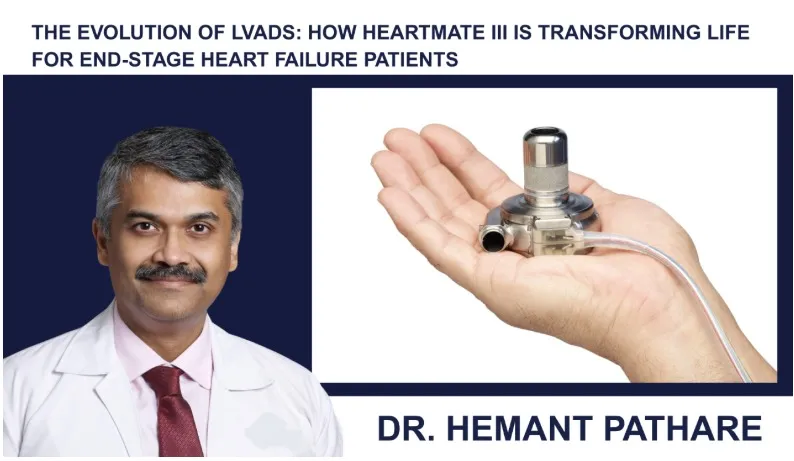
The evolution of VADs—with over 24,000 implanted worldwide—has seen devices become smaller, lighter, and more complex. From the large, pulsatile HeartMate XVE to the HeartMate 2, we have arrived at the HeartMate 3 (HM3) .
The MOMENTUM 3 trial (a 5-year follow-up study) proved that the fully magnetically levitated HM3 is associated with better composite outcomes and higher overall survival compared to older axial-flow devices. In 2026, modern centrifugal-flow devices have achieved 5-year survival rates exceeding 70%. Notably, median survival with the HM3 now exceeds 5 years even for patients ineligible for transplantation.

How it Works
The HeartMate III is a magnetically levitated centrifugal-flow pump. It is attached via an electrical cable (driveline) to a controller and two lithium battery units worn by the patient.
Indications and Timing
Timing is the most important factor for success. While 75% of patients referred for transplant are in the critical INTERMACS category 3, clinics are now moving toward earlier implantation (INTERMACS class 4) to improve quality of life before conditions become critical.
Current Indications include:
● Cardiogenic shock (non-septic).
● Refractory angina not amenable to PTCA or CABG.
● Frequent AICD discharges.
● Intractable symptomatic heart failure despite maximal medication.
● Patients already on VA ECMO.
Contraindications: LVADs are not indicated for patients with active malignancy, uncontrolled sepsis, ongoing substance abuse, irreversible multiorgan damage, active bleeding diathesis, or complicated diabetes with severe peripheral vascular disease . For very sick patients with multiorgan failure, the only realistic bridging strategies are VA ECMO and CentriMag™.
2026: A New Era of Technology
The landscape of advanced therapies is changing rapidly through:
● Fully Implantable Systems (TET): Research is complete for transcutaneous energy transfer to eliminate the external driveline—the leading cause of infections.
● AI Integration: Artificial Intelligence now monitors pump data in real-time for automated hemodynamic support and predictive alerts for complications like pump thrombosis.
● Physiological Adaptability: “Smart” speed modulation mimics the native heart by increasing flow during physical activity.
● Enhanced Safety: Advanced magnetic levitation and “artificial pulse” features have reduced strokes (minor rates of 8-11% over 10 years) and GI bleeding (17-40%).
● New Protocols: 2026 guidelines support lower intensity anticoagulation or even eliminating aspirin.
Bridge to Recovery and Accessibility
While heart transplants offer a median survival of >14 years (with 1/3 surviving >20 years), LVADs are opening new doors. Through Bridge to Recovery (BTR), some specialized centers report device removal rates as high as 20% because the native heart heals enough through LVAD support and medications like SGLT2 inhibitors.
Global Adoption & Costs:
● Surgical Shifts: Standard procedures are moving from full sternotomies to less invasive thoracotomies, thus reducing recovery time.
● Expanded Eligibility: Therapies are now offered to patients over 75 and those with higher BMIs.
● Cost in India: Currently, an LVAD costs approximately 1 crore, but future “Made in India” pumps could bring this cost down to 20 lakhs.
