
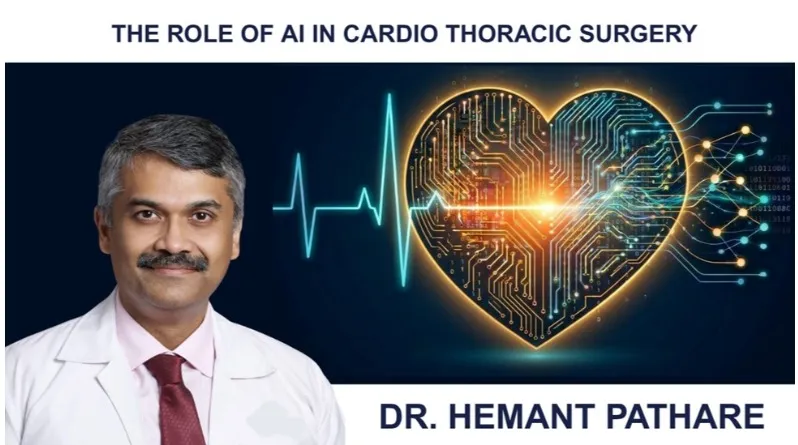
🤖 Science has Progressed from Listening to the Heart… to Predicting Its Future
Artificial Intelligence (AI) is transforming cardiothoracic surgery from a reactive to a predictive discipline. By integrating high-tech computational systems into the operating room (OR), AI enhances every phase of the patient journey—from preoperative risk assessment to real-time intraoperative guidance and postoperative recovery.
🩺 Then vs Now: The Evolution of Cardiac Care
There was a time a century ago when cardiology and cardiac surgery relied heavily on a stethoscope and good history taking. Patients would present with discomfort, breathlessness, or fatigue—and that would mark the starting point of diagnosis.
Today, that starting point is shifting.
We are entering an era where the heart speaks long before it shows signs of distress—and Artificial Intelligence is helping us listen earlier than ever before.
🔍 A Quiet Transformation in Cardiac Care
Modern AI systems can analyze:
- ECG patterns
- Imaging scans
- Patient history
What appears “normal” may still hold hidden predictive signals.
Key Shift
- Detecting disease
- Anticipating disease
Heart failure, arrhythmias, and structural issues can now be identified years before symptoms appear.
⚙️ With AI Integration
- Better patient evaluation
- Data-backed surgical planning
- Reduced risk of late-stage complications
🏥 Inside the Cardiothoracic Operating Room: What Is Changing?
AI is redefining surgical timing and decision-making.
Preoperative Planning & Diagnostics
AI automates segmentation of medical images (Cardiac CT, Cardiac MRI, 3D Echo), accelerating surgical planning and improving transfemoral aortic prosthesis sizing (TAVR). It helps in assessing anatomic structures and formulating personalized treatment plans.
AI creates “digital twins”—dynamic 3D replicas of a patient’s heart from CT scans—allowing surgeons to simulate procedures and identify anatomical variations before the first incision.
Machine learning models also outperform traditional scoring systems like EuroSCORE II in predicting mortality and risk for specific complications such as acute kidney injury (AKI).
Intraoperative Support
Computer vision and AI assist in instrument recognition, surgical workflow segmentation, and robotic-assisted surgeries. These technologies help reduce surgical errors and improve efficiency.
In the operating room, computer vision acts as a “silent sentinel,” tracking surgical phases, instrument movements, and even blood loss in real time. It provides alerts if surgeons approach critical structures and helps monitor the cognitive load of the surgical team.
Robotic-Assisted Cardiac Surgery
Systems like the da Vinci robot use AI to filter hand tremors and enable finer movements than a human hand alone.
Emerging AI-driven robotic platforms are progressing toward semi-autonomous execution of simple subtasks like suturing.
Postoperative & ICU Management
Machine learning algorithms in the ICU analyze continuous data streams (vital signs, laboratory results) to predict life-threatening complications such as sepsis or atrial fibrillation 4–6 hours before clinical signs appear.
Operational Efficiency
AI improves hospital logistics by predicting case durations with 15–30% greater accuracy than surgeons, helping optimize operating room scheduling and reduce costs.
📈 Emerging Research and Trends
Recent studies (2024–2026) show a rapid rise in AI research, particularly in high-stakes areas such as heart transplantation to optimize organ allocation and predict graft survival.
Innovative work is also being conducted in “cognitive surgery,” where AI focuses on team coordination and human-machine collaboration to minimize errors.
Outcome Shift
Skill + Timing + Data = Better Patient Outcomes
🤝 Technology Meets Clinical Wisdom
AI enhances—but does not replace—the clinician.
The Balance
- Data Intelligence
- Clinical Experience
- Human Connection
The real strength lies in the fusion of technology and intuition.
🚀 Looking Ahead: The New Model of Care
Future of Cardiology and Cardiothoracic Surgery
- Predictive
- Preventive
- Personalized
Benefits and Future Directions
- Reduced complications: AI helps predict complications such as acute kidney injury and cardiac arrhythmias after cardiac surgery, allowing earlier intervention.
- Optimized workflows: AI reduces time for preoperative tasks and helps manage postoperative ICU data streams more effectively.
- Improved efficiency: AI models can predict operating room durations and reduce delays.
Challenges
- The “Black Box” Problem: Many high-performing AI models lack explainability, making it difficult for surgeons to trust decisions without understanding the underlying logic.
- Data Integrity & Bias: AI models can be biased if trained on non-representative datasets, potentially leading to inequitable outcomes for minority populations.
- Implementation Costs: Substantial investment in software and staff training is needed.
- Liability & Ethics: Accountability remains a major hurdle—it is still legally unclear who is responsible (surgeon, developer, or hospital) if an AI-influenced decision leads to a surgical error.
🧾 Closing Thought
We are no longer questioning, “How do we treat heart disease?” We are now asking, “How early can we stop it from progressing?”
AI is helping us understand the heart’s signals earlier, more deeply, and more meaningfully—allowing us to act before time does.
