
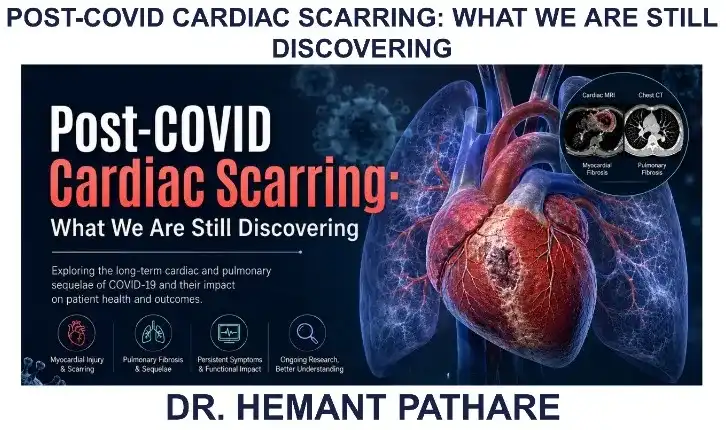
Understanding the Long-Term Cardiac and Pulmonary
Effects of COVID-19
Introduction
While the acute phase of the COVID-19 pandemic has largely passed, its long-term health effects
continue to emerge. Increasing evidence suggests that recovery from COVID-19 does not always
mean a complete return to pre-infection health, particularly for the heart and lungs.
Initially recognized as a respiratory illness, COVID-19 was soon found to affect multiple organ
systems, including the cardiovascular system. Today, clinicians continue to encounter patients
who experience persistent symptoms such as breathlessness, fatigue, reduced exercise tolerance,
chest discomfort, and palpitations months or even years after infection. Advanced imaging has
revealed that some of these patients have residual myocardial inflammation, cardiac scarring
(fibrosis), or chronic pulmonary changes.
From a cardiac surgical perspective, these findings are particularly relevant. Patients presenting
for bypass surgery, valve procedures, or other cardiac interventions may have underlying post-
COVID cardiac or pulmonary abnormalities that can influence treatment decisions and recovery.
Although our understanding has improved significantly, many questions remain regarding the
prevalence, clinical significance, and long-term consequences of post-COVID cardiac scarring.
As research continues to evolve, we are gaining valuable insights into the lasting impact of
COVID-19 on cardiovascular and pulmonary health. This article explores what we currently
know—and what we are still discovering—about these important post-COVID sequelae.
The Heart’s Vulnerability to COVID-19
From the earliest stages of the pandemic, physicians observed that COVID-19 affected far more
than the lungs. Many hospitalized patients exhibited elevated cardiac biomarkers, abnormal
electrocardiograms, arrhythmias, and signs of myocardial injury.
Researchers soon discovered several mechanisms through which the virus could affect the
cardiovascular system:
Direct viral injury to heart muscle cells
Excessive inflammatory responses
Microvascular damage and clot formation
Immune-mediated myocardial inflammation
Increased physiological stress on the cardiovascular system
Short-Term and Acute Cardiac Effects
During the initial phase of a SARS-CoV-2 infection, the virus uses ACE2 receptors
which are present in large numbers in the heart muscle and the endothelial lining of
blood vessels.
This can trigger several acute issues such as :
Myocarditis and Pericarditis:
Direct viral invasion and the immune response cause dangerous inflammation of
the heart muscle (myocarditis) or the protective sac surrounding it (pericarditis).
Arrhythmias:
Disruption of the heart's electrical pathways can cause irregular heartbeats, most
commonly atrial fibrillation.
Blood Clots:
Inflammation alters how the blood vessel lining behaves, creating a high-risk
environment for micro-clots and large blood clots that can trigger strokes or heart
attacks.
Acute Heart Failure:
Severe respiratory distress and a “cytokine storm” can overtax the cardiovascular
system, causing the heart muscle to weaken and fail to pump blood efficiently.
While many patients recovered without permanent consequences, others developed
varying degrees of myocardial injury that, over time, resulted in fibrosis—or what is
commonly referred to as cardiac scarring.
What Is Cardiac Scarring?
Cardiac scarring occurs when healthy heart muscle tissue is replaced by fibrous tissue following
injury or inflammation.
Unlike normal heart muscle, scar tissue cannot contract efficiently. Depending on its location and
extent, scarring may interfere with the heart's electrical conduction system, reduce pumping
efficiency, and increase the risk of rhythm disturbances.
Modern imaging techniques, particularly cardiac MRI, have revealed evidence of residual
myocardial scarring in a subset of patients who previously experienced COVID-19—even
among some individuals who were not critically ill during their initial infection.
Although not every scar leads to clinical problems, its presence raises important questions
regarding long-term cardiovascular health.
Long-Term Risks and Long COVID
Recent medical tracking shows that cardiovascular risks do not vanish after the initial
virus clears. Individuals recovering from COVID-19 may experience ongoing
complications that linger for months or years:
Accelerated Vascular Aging:
Extensive multi-country studies indicate that
COVID-19 survivors display stiffer, less flexible arteries—essentially making
blood vessels behave like those of a significantly older person.
Plaque Progression:
The virus can infect cells inside preexisting arterial
plaques, creating localized inflammation that destabilizes the plaque, making it
up to three times more likely to rupture and cause a heart attack.
Autonomic Dysfunction (POTS):
The virus can damage the autonomic nervous
system, leading to Postural Orthostatic Tachycardia Syndrome. This condition
causes a patient's heart rate to spike dangerously just by standing up.
Persistent Symptoms:
Roughly 15% of patients encounter long-term
cardiovascular symptoms like chest pain (angina) and palpitations as part of
Post-Acute COVID-19 Syndrome (PACS).
What Are We Seeing in Clinical Practice?
In surgical and cardiovascular practice, the post-COVID period has introduced new clinical
considerations.
Common presentations include:
Persistent fatigue and reduced exercise tolerance
Breathlessness disproportionate to imaging findings
Palpitations and irregular heart rhythms
Unexplained chest discomfort
Reduced cardiac function
Delayed recovery following cardiac procedures
In certain cases, diagnostic imaging reveals subtle myocardial fibrosis or residual inflammatory
changes that may contribute to these symptoms.
The Pulmonary Connection
The heart and lungs function as an integrated system. Damage to one often affects the other.
Many patients recovering from moderate-to-severe COVID-19 continue to demonstrate:
Pulmonary fibrosis
Reduced lung capacity
Persistent inflammation
Impaired oxygen exchange
Pulmonary vascular abnormalities
These changes place additional strain on the cardiovascular system and can contribute to ongoing
breathlessness, exercise intolerance, and reduced quality of life.
Implications for Cardiac Surgery
The long-term effects of COVID-19 have added a new dimension to preoperative assessment.
Today’s evaluation often includes:
Previous COVID-19 severity
Residual respiratory symptoms
Pulmonary function testing
Cardiac MRI findings when indicated
Exercise capacity assessment
Presence of ongoing inflammatory conditions
While most patients continue to undergo surgery safely and successfully, comprehensive
preoperative evaluation has become increasingly important.
What Does Current Research Tell Us?
One of the most important lessons from recent research is that post-COVID cardiovascular
effects exist on a spectrum.
Researchers continue to investigate:
The prevalence of post-COVID myocardial fibrosis
Long-term arrhythmia risk
Impact on heart failure development
Effects on surgical outcomes
Mechanisms driving persistent inflammation
Although significant progress has been made, many questions remain unanswered, highlighting
the importance of continued follow-up and research.
Moving Toward a Better Understanding
The focus has now shifted from understanding acute infection to understanding recovery,
resilience, and long-term health outcomes.
Advanced imaging, improved surveillance programs, and ongoing research initiatives are helping
clinicians better identify which patients may benefit from closer cardiovascular and pulmonary
follow-up.
Final Thoughts
For many people, COVID-19 is a chapter that has closed. Yet in clinics, diagnostic centers, and
operating rooms, its story continues to unfold. Clinicians are still encountering patients who have
recovered from the infection but continue to experience breathlessness, fatigue, reduced exercise
tolerance, and unexplained cardiovascular symptoms. These cases serve as an important
reminder that recovery is not always defined by the absence of infection—it is often measured by
the body’s ability to fully regain function.
The growing recognition of post-COVID cardiac scarring and pulmonary sequelae is reshaping
our understanding of long-term health. What initially appeared to be a respiratory illness has
revealed itself to be a complex multisystem disease capable of leaving lasting effects on the heart
and lungs. While many individuals recover completely, others may continue to carry subtle
structural and functional changes that only become apparent months or years later.
At the same time, these discoveries reflect the progress of modern medicine. Advanced imaging
technologies, ongoing clinical research, and multidisciplinary care are helping clinicians identify
complications that were once difficult to detect and better understand which patients may benefit
from closer follow-up and intervention. Each new study adds another piece to a puzzle that the
medical community is still working to solve.
Although many questions remain unanswered, one message is becoming increasingly clear: the
end of an infection does not always mark the end of its impact. As we continue to study the long-
term consequences of COVID-19, our focus must remain on early recognition, individualized
care, and continuous learning. The story of COVID-19 is still being written, and every patient
encounter brings us closer to understanding its enduring legacy on the heart, the lungs, and
human health itself.