
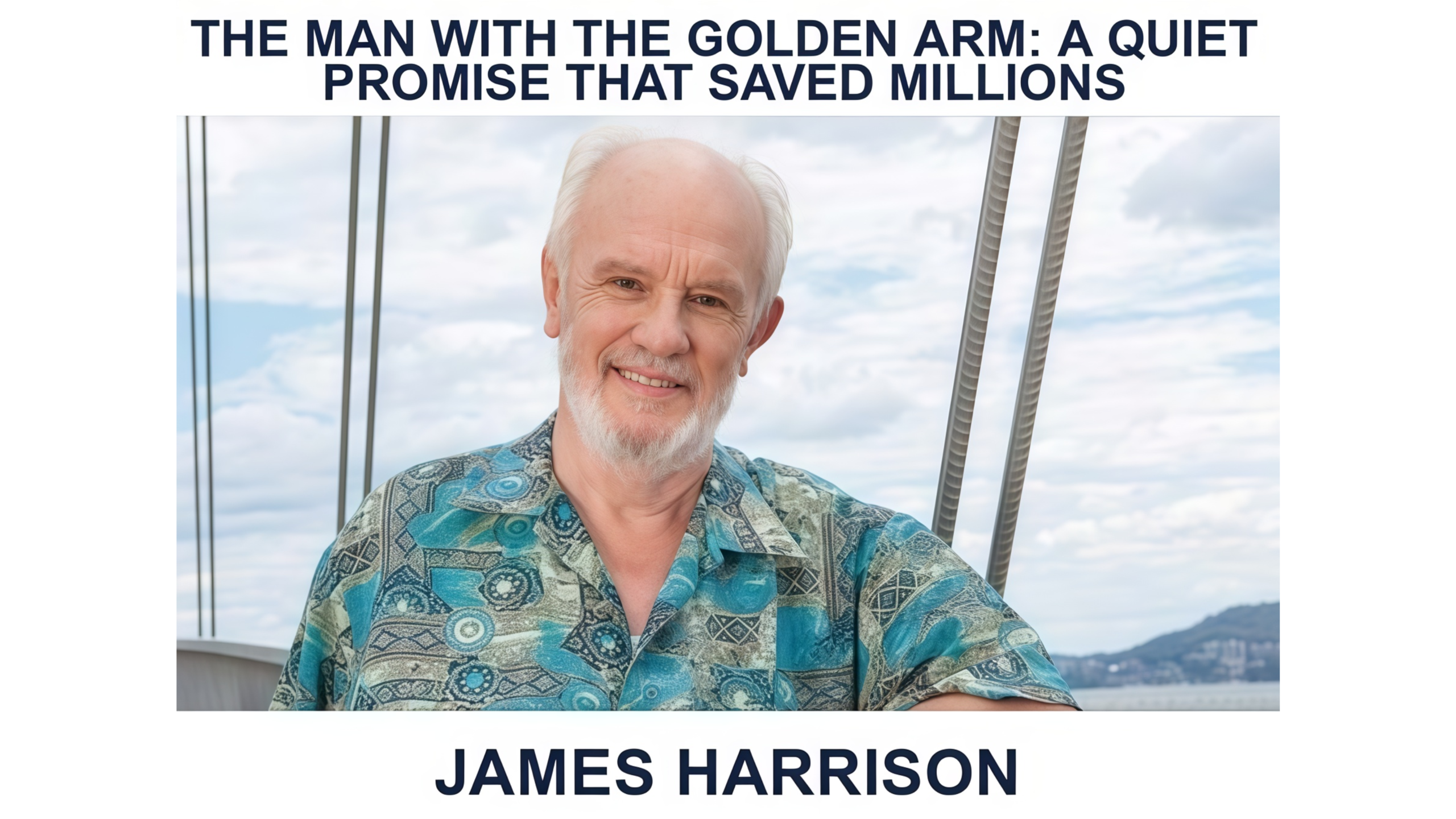
Every week, we talk about leadership, resilience, impact, and purpose. But sometimes, the most powerful lessons don’t come from boardrooms, headlines, or titles. Sometimes, they come from ordinary people who quietly choose to do the right thing—again and again—without recognition. This is the story of James Christopher Harrison OAM, known to the world as “The Man with the Golden Arm.”
In 1951, a 14-year-old Australian boy named James Harrison woke up in a hospital bed with 100 stitches across his chest. Doctors had just removed one of his lungs. To survive, he needed 13 units of donated blood from complete strangers—people whose names he would never know. Sitting beside him, his father Reg said something simple yet life-changing: “You’re only alive because people donated blood.” In that moment, James made a promise to himself. The day he turned 18, he would donate blood and repay the gift that saved his life. There was only one problem—James was terrified of needles.
In 1954, the moment he became eligible, James walked into a blood donation center anyway. He sat in the chair, looked at the ceiling, and let the nurse insert the needle. He never watched. Not once. Not in 64 years. What James didn’t know at the time was that his blood was different. After several donations, doctors discovered something extraordinary: his plasma contained an extremely rare antibody, most likely developed because of the massive transfusions he received as a teenager. This antibody could prevent a deadly condition called Rhesus disease.
Before this discovery, thousands of Australian babies were dying every year. When a pregnant woman with Rh-negative blood carried an Rh-positive baby, her immune system could attack the baby’s red blood cells, leading to miscarriages, stillbirths, or severe brain damage. James’s blood held the answer. Doctors asked if he would switch from whole blood donation to plasma donation. It meant longer sessions—90 minutes instead of 20. It meant donating every few weeks. It meant committing for the rest of his life. James thought about his fear. Then he thought about the babies. He said yes.
For the next 64 years, James Harrison never missed an appointment. He donated while working as a railway clerk. He donated after retirement. He donated through moments of joy and routine, and through deep personal loss. Even after his wife Barbara passed away in 2005—what James later called his “darkest days”—he continued to donate. Every single time, across all 1,173 donations, he followed the same ritual: he looked at the ceiling, chatted with nurses, studied the walls—anything to avoid watching the needle. The fear never left him, but neither did his commitment.
In a remarkable and deeply personal twist, James’s own daughter later needed the very Anti-D medication created from his blood when she became pregnant. His grandson, Scott, exists because of a promise his grandfather made decades earlier. In May 2018, at the age of 81, Australian law required James to make his final donation. The room was filled with mothers holding healthy babies—living proof of his life’s work. There were tears, gratitude, and quiet reverence. James sat in the chair one last time, looked away from his arm one last time, and completed his 1,173rd donation.
Since 1967, more than 3 million doses of Anti-D medication containing his blood have been issued, and scientists estimate that James Harrison’s contributions helped save approximately 2.4 million babies in Australia alone. When people called him a hero, James always dismissed it. “I’m in a safe room, donating blood,” he said. “They give me a cup of coffee and something to nibble on, and then I just go on my way. No problem, no hardship.”
James Harrison passed away peacefully in his sleep on 17 February 2025, at the age of 88. We often search for heroes in movies, history books, or headlines—people with fame, wealth, or power. But sometimes, a hero is simply someone who keeps a quiet promise for 64 years. Someone who feels fear—real, persistent fear—and chooses to do the right thing anyway. Millions of people are alive today because one man decided his fear mattered less than their lives. That is leadership. That is service. And that is the extraordinary power of showing up, consistently, for a lifetime.
